Gaming

Home Gaming
Tips, strategies, and hard-won wisdom for DMs and players who want to run better games and have more fun doing it.

Fantasy Adventure Ideas and Inspiration

Fantasy adventurers

Sometimes Dungeon Masters need a little inspiration when creating one-shot sessions, or even multi-session campaigns. There are classic tropes and their variations that can be relied upon for ideas, they just need a new twist to make them interesting.

Other times you want something truly unique. Taking ideas from other sources and spinning them on their heads can help.

Here are some ideas to help spark your creativity. You can use these directly, modify them slightly to suit your tastes and the party’s situation, or make a 90 degree turn and go somewhere entirely new. It’s up to you!

Rescue! One of the most common and old-school themes in fantasy adventuring is the rescue. The king’s daughter has been captured by foul enemies. The party is hired to infiltrate the baddie’s lair, find the princess, and get her out alive.

Twist: One of the party’s own has been captured and their comrades must rescue them.

→ Be sure to check out 30 Adventure Ideas for Dungeon Masters

Exploration. Some ruins have been discovered and the party explores it, either for their own effort to seek treasure, or because they’ve been hired by a powerful NPC to survey and map the situation. The location is where your creativity can really shine; make it someplace unusual, such as a mysterious keep or monastery that appears overnight, or a large abandoned ship that has washed ashore.

Twist: The party must explore a location with a time limit, because a prophecy or some other clue indicates it will disappear at a particular time in the near future.

Escape. One of the most exciting, challenging — and common — adventure ideas entails the party finding themselves held captive without weapons or armor deep inside an unknown dungeon. They must escape their bounds, find their gear, and escape. The reason for their capture can be any number of things: they passed out at an inn and woke up in shackles (perhaps they were shanghaied and found themselves bound on board a pirate ship); they were infiltrating a Big Bad Evil Guy’s lair and were captured, etc.

Twist: An NPC in their party betrayed them and handed them over to the party’s enemy. Not only must they escape capture, but they also seek revenge against their betrayer.

Destruction of Evil. This may be the most common adventure trope yet, the destruction of an evil altar or temple. Don’t sell the idea short; it is used so often because of its versatility and applicability to the fantasy genre. The source of evil can have any number of variations, such as a competing religious sect or a group of monsters that must be destroyed or driven out of an area. If it’s a place to be destroyed, it can be a variety of things, such as an altar, an entire temple, or a single artifact. The thing to be destroyed can, of course, be a person or particular monster.

Twist: For a longer, more challenging campaign, the evil can be a Thieves or Assassins guild that must be infiltrated from within. To put a spin on the more classic idea, the party must identify the source or location of evil first before they attempt to destroy it — or the source of evil keeps moving (a temple that magically changes location every week, etc.)

There be Dragons! Dragons are arguably the most iconic monster in fantasy adventure games. Ridding a village of a marauding dragon is a tried and true adventure hook. But don’t be afraid to throw some new angle on it. Perhaps the dragon is actually of good ilk but has been possessed by a demon. Does the party kill the dragon outright, or try to exorcise its evil host thus saving the dragon’s life (who doesn’t want a grateful dragon on their side)? Sometimes the party must subdue or capture a dragon, but what if their intent is to retrieve dragon eggs or younglings without engaging the parent in combat (who would most likely wipe them out if confronted directly)?

Twist: In one campaign, my party emerged from a short adventure inside an evil temple to discover a green dragon and a black dragon of relatively equal strength fighting each other in the air above them. I allowed the party to take on the two dragons and role-play the battle. Once that dragon duel was resolved and only one dragon remained, the party then had to fight the wounded and weakened beast that remained (as their main characters). Another idea is for the party to discover a dragon in a compromising position, such as a wyrm in chains or weakened because of a prior battle. Another variation is for the party to meet an intelligent, speaking dragon and convince it to do something against its nature.

Gather Ye Weapons. Like the Marvel Universe story line, the party must gather a particular set of artifacts, each with its own set of challenges, to create a new weapon that is used to counter some Big Bad Evil. A complication you can add to this is some evil person or group is also seeking the artifacts, motivating the party to act quickly to get them first. The classic AD&D module, White Plume Mountain, is a great example of this adventure type.

Twist: The party must replace a heavily guarded item or weapon with a fake without being detected. Or, the party is hired by a powerful NPC to retrieve an item, but along the way they discover their benefactor intends to use the item for evil, so they find a way to thwart the NPC instead.

Out There Ideas

These ideas deviate dramatically from the common tropes and themes listed above. One of the best things about fantasy table-top role-playing games — or any genre, really — is the fun is limited only by your imagination. Sometimes it’s fun to let your imagination run wild.

Some of these ideas are straightforward, while others are truly ‘out there.’

Infection. The party has been infected by a curse that will turn them into vampires within a fixed number of days. They must retrieve a magic item or reagent used for a potion to effect a cure.

Post-Death. The party has been slain and they find themselves in the land of the dead. Magic works very differently, or not at all, and many other things are turned on their heads. They must achieve some goal in order to return themselves to the living.

The Circus. The party has been captured by a low-level demon and placed in a zoo or circus on one of the planes of the Abyss. They must escape and return to the prime material plane.

Run Away! By chance, the party finds themselves face to face with a group of monsters in the wilderness that is substantially more powerful than themselves. They must flee enemy territory and survive long enough to cross a border or land feature such as a river or mountain range without being killed or captured.

Another Body. Because of a freak magical accident, the party finds themselves inhabiting the bodies of hobgoblin soldiers in a war party’s camp preparing to attack a nearby keep. The party learns a powerful human cleric inside the keep has the ability to exorcise them and restore them to their original bodies. They must reach the cleric, explain their true identities, and convince the priest to help them before they all get killed in the attack.

Thoughts on D&D Play Mechanics

Dungeons & Dragons

I’ve been a D&D Dungeon Master since 1980. In that time, my play style and table rules have evolved. Here are my thoughts on some of the more contentious ones.

Initiative (side, individual, roll every round)

Rules for how to handle initiative have evolved since the first editions of D&D back in the 1970s. The Basic rules (Moldvay) stated that each side in a combat encounter rolled for initiative and that order held for the rest of the combat.

Some folks roll initiative for each monster and each character, holding that order throughout the encounter.

Yet another variation is to re-roll for initiative, either for each side or for each individual, every round.

This presents four variations, and there are situations where each makes the most sense. I don’t subscribe to the idea that one variation is so superior to the other three that it must be used at all times and at all tables.

Just like every rule in the books, whichever edition you choose to play, the group can choose which they like best.

My previous preference was to use individual initiative so that the strengths and weaknesses of each monster or character can play a part. I kept that order throughout the combat. I’m now a fan of side initiative as it keeps things simpler and goes faster.

Morale

Historically I have never used morale checks in my games as a DM, nor have any of the DM’s I’ve played under. On rare occasions, the DM would make a judgement call and say something like, “The rest of the kobolds, after seeing the majority of their group slaughtered before their eyes, drop their weapons and surrender, throwing themselves at the party’s mercy.”

After reading over old-school rules, specifically the Basic and 1st edition AD&D rules, I think that checking for morale makes a lot of sense based on the typical morale scores of monsters as specified in the various texts, and at prescribed moments in the combat such as when a group of monsters lose their leader or more than half of their number have been slain.

Encumbrance

As with morale, I have never used encumbrance rules when DMing in the past. It’s one of those things that makes a lot of sense from a plausibility and realism standpoint, but I’ve felt that tracking encumbrance is a tedious pain in the arse.

I’m still on the fence about whether or not I’ll use it at my table.

Death

Historically, I have ruled that a character becomes unconscious at 0 hit points, and loses 1 hit point her round until they receive healing (not just first aid as specified in 5th edition rules), and dies if they reach -10. Of course, if a player has a few hit points above zero and receives damage that takes them below -10 all at once, they’re dead.

5th edition, in my opinion, makes it far too easy to stay alive. The concept of death saves feels a bit gratuitous in favor of keeping characters kicking. I don’t subscribe to that model nor have I ever used it when DMing 5th edition games.

Conversely, the original Basic rules specified that when a character reaches 0 hit points, they’re dead. Period. I’m okay with that as long as the table is okay with it. It makes players more cautious in their actions, and I think that serves the game. I think it gives more emotional weight to the stakes.

One additional note I have about death is that when resurrected, a character loses 1 point from their Constitution score, and cannot be resurrected any more times than their original CON score.

Critical Hits and Misses

I have always ruled that a natural 1 on a d20 attack roll meant automatic failure regardless of bonuses. Along with that natural 1, I’ve typically specified that something awkward or unfortunate occurred, such as tripping or dropping their weapon. I have also ruled that a natural 20 on an attack roll always hits and does double damage; this is calculated by rolling the damage dice twice, adding them up, and then adding any bonuses to that sum.

I haven’t always handled natural 1’s or monster attack rolls in the same manner, however. They were an automatic miss but didn’t have any deleterious effect. Natural 20s were automatic hits and did double damage, of course.

Some tables I’ve played at, however, didn’t consider natural 1s or natural 20s as anything special. They were a result from a d20 roll just like any other.

On further reflection, I think a solid table rule should be that if the player characters suffer negative effects on natural 1’s and get double damage on natural 20’s, monsters and NPCs should, too.

Identifying magic items

Thinking back to all the games I’ve DM’d in the past, I realize that I have been a bit too generous to players when they discovered magic items. I’d simply say something like, “The chest contains 500 electrum pieces, 800 silver pieces, a +1 dagger, and a Wand of Fireballs.”

As previously stated about encumbrance, I never worried about how the party could carry their loot, either.

I never made the characters go through hoops to identify the magic items or their properties, unless the weapon was cursed, at which point I’d inform them that what they thought was a +1 sword was actually a -1 Backstabber. Oops.

After careful thought, I have changed my ways. Potions must be sipped to get hints about their purpose. Other magic items or weapons must be used to determine their purpose and function, otherwise the players must hire expert help at high cost to get the skinny on what that wand really does.

I’m also of the mind that the player would have no way of knowing how many charges a Wand of Fireballs has until it runs out. I’d keep track in my own notes.

Fudging rolls

I have fudged many rolls as a DM, especially in recent years. Because I have historically been a “story” dungeon master, focusing on a great story that fit a cohesive theme, bad dice rolls could detour a party in a direction I didn’t want them to go.

This DMing style is also called “railroading” and I’ve since given that up to being an almost 100% sandbox-type dungeon master. This has enabled me to make other changes, too, specifically allowing the fates of the dice rolls to fall where they may.

There are still rolls I don’t let the party see, such as Hearing Noise or Move Silently checks, but I no longer fudge rolls.

Player activity reflects character activity

One of the new rules my groups and I have agreed to implement is the mandate that if a group of players are arguing loudly about something, their characters are, too. Wandering monsters become much more likely to show up under those conditions. (I’ll often warn the players that their real-world argument will soon bleed into the game if they don’t resolve it and move on.)

Also in recent years I have banned the consultation of Monster Manuals during game play. I may look up a monster’s stat as part of my DM duties, but the players don’t get to.

Consulting the Player’s Handbook during play is a bit different, though. Spell casters need to be able to have full understanding of their spells to make good choices for their characters, but having the PHB handy during play can lead to min-maxing (making choices to optimize rolls, stats, and results that don’t necessarily coincide with sound role-playing).

So, I have come up with the table rule that if the player wants to consult a book during play (other than the Monster Manual), their character is setting down their pack or Bag of Holding, rummaging around inside to find it, and spending time thumbing through pages to find what they’re looking for. This wastes the party’s time and obviously can’t be done while on the move or during combat, else there will be consequences in-game.

Monster reaction rolls

As with morale, I never used monster reaction rolls until recently. I like letting the dice make some more decisions for me as I’ve already got enough on my plate. Letting the dice decide a monster’s reaction at the start of an encounter also lends itself to the sandbox style of play. The dice can take the party in whole new directions and rolling for monster reactions is one way that can happen. I even let the party see the dice roll.

I also use reaction rolls for NPC encounters, too, although I still role-play NPCs as I think a good DM should.

Tracking resources

Like encumbrance, tracking rations, water, rest, and consumables like torches, lantern oil and arrows is a realistic thing to do but is a bit of a pain. There are many DMs on YouTube and social media who have shared their methods and tools (checklists, basically) to make tracking these consumable resources easier.

On the one hand, tracking consumables seems like a tedious mechanic. But, I have found — and my players have, too — that this adds to the atmosphere and even the strategy of the game’s role-playing aspects (up to a point). If the party wants to explore deeper in the dungeon but won’t have enough torches to see their way back to the surface, they must leave now and return another day better prepared. The same goes for healing and spell availability, so tracking consumables like torches and food isn’t really any different if you think about it.

An additional tip is to assign these tracking duties to an honorable and honest player in the party. Delegate it for the win.

Disclosing monster stats

I’ve disclosed monster hit points and armor class in the past, but no more. Now, “the manticore isn’t even bloodied” when it’s above 50% of it’s hit points, and “the beast has blood on its limbs and is showing signs of fatigue” when it gets down to around 25% of remaining damage. When it’s nearly dead, I’ll say something like, “The manticore has many visible wounds, is breathing hard, and seems to be close to death.”

A monster’s armor class is never disclosed but the party can often do the math to glean the target number after several hits or misses in their attack rolls.

Sometimes a successful hit according to the d20 still doesn’t hit or doesn’t do the full damage due to the monster having some kind of immunity or resistance. The party figures this out over time, but unless they are already familiar with the monster’s characteristics, it’s not immediately obvious.

This brings up another point about monsters. I used to say, “You walk into the room and see a manticore…” Now, I describe the way the monster looks and let the party figure out what it is. Unless it’s a group of orcs or kobolds, something everyone already knows and could easily identify; in that case I just say, “You see a group of around a dozen orcs staring at you from across the room.”

Sandbox: Multiple players

I’ve really come to enjoy the sandbox style of DMing. I’ve always been a story-driven “railroad” kind of DM in the past and it’s still my nature to design campaigns in the story-centric way. I’ll leave it to you to research on your own the difference between sandbox and railroad styles of D&D gaming.

[NOTE: I prefer the term “story-driven” play style over “railroad”; I’m using the latter term here as it seems to be the currently fashionable way of describing that campaign style.]

One aspect of traditional sandbox D&D games that fascinates me is the idea of one or two DMs running a campaign with a collection of up to 50 different players participating — yes, 50! A play session is scheduled and the players that show up get to play, regardless of the make-up of the party from previous sessions.

The DM must keep track of what happens in their sandbox milieu, which monsters are slain and treasure recovered, etc. The players go about their business and if today’s group happens to wander into a dungeon that was cleared out by another group of players the week before, they find bodies of slain monsters (or characters!) being eaten by rats and opened chests devoid of treasure.

I think this method of play has a lot of advantages but it puts a bit of a burden on the DM (or DM’s) to accurately and thoroughly track what transpires during each session.

Railroading: aka The Story-Driven Campaign Style

As mentioned previously, I’ve historically been a railroad or ‘story-driven’ DM. I would create detailed settings with elaborate notes about what is were, what’s happening behind the scenes, and carefully choreographed encounters designed to ensure my plot unfolds like a brilliantly written story.

This has been fun and well-appreciated throughout my DM career, but one particular event in a particular campaign a few years ago made me realize the potential pitfalls with running a railroad campaign.

I had things carefully and thoughtfully planned out, but the party made a choice — with full knowledge of the consequences — that completely derailed the campaign’s planned trajectory. It ended the entire campaign halfway through and some players even left the game entirely.

I was not only frustrated, I was furious. This took place roughly halfway through a rather long and thoroughly planned campaign, which meant that 50% of my hard work just got flushed down the drain — and the party did it by choice, knowing this would be the result.

They didn’t do this specifically in rebellion to my play style. They explained their rationale, and it had nothing to do with whether it was a sandbox or railroad type of campaign.

Ultimately, they wanted to maintain their sense of agency even though it ended the campaign’s plot. I’ve since learned to value player agency far more than I ever used to.

But, if this had been a sandbox style game, it wouldn’t have mattered. The party’s choice would have been handled just like any other and play would have continued, just in a new and equally valid direction.

When this happened, I had never heard of the sandbox style of game play. I’ve since grown to love and embrace sandboxed games and, thinking back, recognize just how powerful and useful it would have been in that situation.

I still could have had my “grand plan” in place, ready for the players to discover. But it would have been designed in a way where that discovery wasn’t a requirement. It was simply there, ready to be found. I have also learned I don’t need to prepare things to nearly the same degree of detail as before.

I have calculated that in my story-style DMing days, I spent an average of 15-20 hours of preparation for every hour of actual game play. I loved every minute of it, but that’s not sustainable. Sandboxing still allows me an adequate amount of creative time to come up with settings and the beasts and traps and tricks and other fun things that inhabit it — something I enjoy doing — but I spend less than half the amount of time doing it. And the players are having a great time with all the sense of agency they could ever want.

People and Roleplaying Games

Adventuring party in corridor

I have been running D&D games at my local library since October of 2023. Since that time various players have come and gone. Most have only played a few times prior to joining the group, or they played a fair bit but long ago.

Of those players that have participated once or twice and then left the group, all but one did so without giving a reason why. The one player who gave a reason stated they felt the old-school rules we were following made it far too likely for their character to die. Based on that feedback and the input of the players that stayed, we adjusted our table rules to address it (with a death save based on CON score).

As a Dungeon Master, if I were running a story-driven game, it would be very frustrating to have players come and go like that. Not knowing what the party makeup would be from one session to the next would wreak havoc on my planned campaign. Considering I’m using a more sandbox style approach, where the players decide what they want to do and where they want to go, it’s been a lot easier to handle the shifting party.

Throughout this process, it has been interesting to see the different dynamics and motivations for each player. Some joined the group because they’d dabbled in 5th edition but wanted to give old-school play a try. Others had played 5e and found it lacking for various reasons. Others have only played 1980s or even 1970s rules and never tried the latest editions.

Dungeon Masters are there to serve the players, not the other way around.

Each player has their own motivation of why they show up to a game, and each player has their own play style and preferred reason to stay. For example, some really like role-playing their character and get a lot of enjoyment when interacting with NPCs in town. They’ll get into character and delve into the nuance of negotiating with a jewelry merchant, the innkeeper, or Captain of the Guard.

Other players like the tactical strategy of planning a raid on an orc lair and leave their interaction with a vendor back at town to single sentences. “Do you want to buy this battle axe I took from a dead orc chieftain or not?”

There is a bit of advice on YouTube that DMs should cover the bases and ensure every game session has something to suit the diverse motivations and desires of all possible player types. I don’t think this is bad advice but I do feel it’s difficult to accomplish in each session. Rather, I prefer to have one session devoted to the tactical combat and strategy, while another is focused more on the role-playing aspects of the game.

As an author, I’ve learned the value of capturing my reader’s attention and holding it fast with intense action, then giving them a breather chapter where not much happens — or nothing dangerous, anyway. Filmmakers have learned this maxim decades ago. Like most pop songs, there’s a particular pattern and rhythm that people unconsciously expect. I think a D&D campaign can follow an ideal rhythm, too.

Ultimately, though, a good Dungeon Master isn’t a songwriter or artist or author, where their work is an expression of themselves and their audience can either like it or not. Instead, I think a Dungeon Master is a facilitator. They learn the desires of the players at their table and dynamically create an experience that suits them best.

The DM may tailor their game in a particular way for the players around their table, but as players come and go what worked yesterday may not work tomorrow. Flexibility and the ability to read the room is an important soft skill for the DM as they strive to make the experience as fun as possible. They are there to serve the players, not the other way around.

Death and the CON Save

Bring out your dead!

The party I run uses Old-School Essentials Advanced Fantasy rules, modified slightly to adhere more toward AD&D/1e rules rather than Basic/Expert/BECMI rules. Having said that, we started off following the “death is at 0 hit points” rule but the players quickly came to the conclusion that this made death for 1st level characters too likely.

So we engineered a solution that lies somewhere between death at -10 (AD&D) and death at 0 (BECMI). We call it a “CON save.“

Unconsciousness

Characters who reach 0 hit points are unconscious and cannot be revived until they receive healing, such as a full and uninterrupted night’s sleep (8 hours) or magical healing such as from a Cure Light Wounds spell or healing potion.

A full night’s uninterrupted sleep will bring the character to 1 hit point and they will regain consciousness.

Magical healing will restore hit points according to the rules based on the type of magic used.

CON Save

If a character is between -1 and -9 hit points, they are not only unconscious but are also in shock and have a high likelihood of eminent death. If a character reaches -10 or lower hit points for any reason or for any duration, they die.

The player must roll a Constitution check for their character. To do so, they subtract their negative hit points from their CON score and roll d20. If they roll equal to or less than their modified CON score, their character goes up to 0 hit points and are unconscious (see “Unconsciousness’ rule above).

If they roll above their modified CON score, the character is dead.

For example: Farkle the Fighter (1st level) has a CON of 18 (born lucky). He is struck by the tail of a dragon (maybe not so lucky) and slammed into a wall, taking him to -4 hit points. This means his modified CON Save score is 14 (18 minus 4). He rolls a d20 and must get 14 or lower to survive. Anything above that and he dies.

He rolls a 13, which means he is now at 0 hit points and unconscious (lucky after all), and if he can get healing from the rest of the party, he’ll survive (with an interesting story to tell; “Don’t go into the light!”)

NOTE: It may be mathematically impossible for characters with some low CON scores to make a CON Save. For example, a character with a CON of 6 cannot survive being brought to -6 or lower hit points; at -5 hit points, they must roll a 1 on a d20 to survive.

A comparison Between 5e D&D and OSR

The Dungeons & Dragons old-school renaissance (OSR) has gotten a lot of steam in the past few years, almost to the point of it being a fashion statement. And lets not forget the huge impact 5th edition had making the D&D hobby popular again, in some ways bringing it back from the dead (D&D was never dead but it definitely had a long lull in popularity). The latest edition, 2024, has apparently been the fastest-selling D&D rule book of all time.

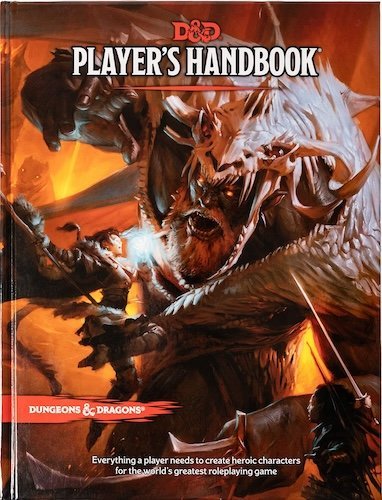
5e Players Handbook
5e Players Handbook

The hit Netflix show, Stranger Things, helped bring D&D back into the popular lexicon. When celebrities came out of the nerd closet to reveal they were huge fans of the game (Vin Diesel, Stephen Colbert, etc.) D&D became cool again.

Fifth edition (5e) brought in a lot of money for its publisher Wizards of the Coast and its parent company Hasbro. Many people new to the game got their first exposure to the game around a table, both in person and virtual, playing fifth edition rules.

The old grognards busted out their nostalgic rule books from the late 70s and early 80’s to boldly declare on social media and YouTube, “I’ve loved this game since before it was cool.”

Almost as a rebellion against the new kids’ game, the old rules saw a resurgence. New companies producing modern printings of those old rules like Old-School Essentials and OSRIC got traction and attention. You could get your hand on the ancient way of playing without having to pay several hundred dollars for a dog-eared and battered AD&D Players Handbook or Dungeon Masters Guide circa 1980.

Regardless of the version of rules you play, it’s still D&D. But that comparison is a bit like saying lasagna and sushi are both food. It’s a true statement but the differences really matter to the experience you have.

Now that both current and old-school versions of the D&D game are available (a great thing!) which do you choose? If you’ve played both, or ran both old and new versions of D&D as a Dungeon Master, you’ve already formed a preference. For those who have only played 5e but keep hearing about this “old-school renaissance” the grognards keep talking about, how do you figure out which edition is more fun to play?

What if you’ve been playing AD&D since 1980 and have never sat at a 5e table?

Best vs Most Fun to Play

Like comparing vanilla ice cream to chocolate, it’s best not to discern which is best. Instead, which do you enjoy the most? It’s a subjective comparison and will be unique to every individual.

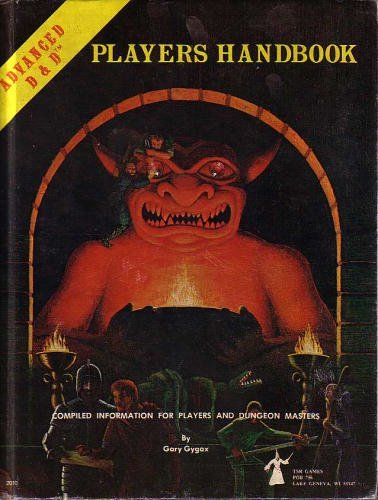
AD&D Players Handbook
AD&D (OSR) Players Handbook

Comparing editions or rules-sets of Dungeons & Dragons is the same way. There are functional differences but deciding which to play is a subjective opinion determined by the individual. What’s vanilla to you may be chocolate to someone else.

Instead of analyzing data and making an algebraic determination of which is best between old-school rules and the 5e set, we’re going to describe the functional differences and let that guide you to a personal and subjective opinion of which seems more fun to play.

For the sake of this article, we’re going to use 5e to refer to the current set of rules being produced by Wizards of the Coast (WotC), and OSR to refer to the collective set of rules produced by TSR, the original creators of D&D, even if they are currently printed by modern publishers (like Necrotic Gnome).

There was Advanced Dungeons & Dragons (AD&D) or as many people refer to it as 1e for first edition (which isn’t technically correct; it wasn’t the first but was preceded by Original Dungeons & Dragons). There was Basic/Expert; and there was BECMI, which was a collection of Basic, Expert, Companion, Master and Immortal rules.

In this article, we’re going to focus on the collection of AD&D since that’s the closest analog to today’s official 5e rules set.

Key Differences

There are some big differences between OSR and 5e, and some subtle ones. Perhaps the most obvious difference to anyone playing both is character creation and the range of class and race options.

Classes and Races

In the Basic rules, you could choose between cleric, fighter, magic user and thief. All were human. You could also play a dwarf, elf or halfling. These were races but they were also their own class (“race-as-class” as it was called). You weren’t a dwarf fighter, you were just a dwarf, for instance.

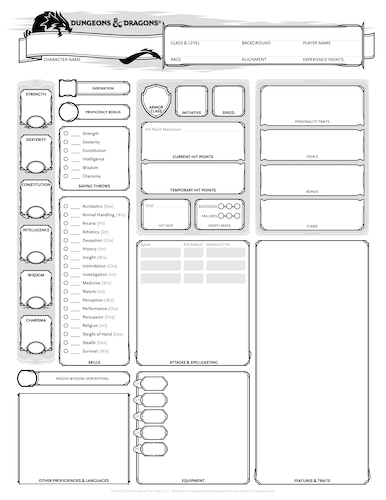
5e Character Sheet
5e Character sheet

In AD&D, there was no race-as-class. You chose your race (human, elf, dwarf, halfling, half-elf, gnome and half-orc), and your class (cleric, druid, fighter, ranger, paladin, magic user, illusionist, thief, assassin or monk). Some races were limited to which class they could be, or the maximum level they could attain.

In 5e, like AD&D, there is no race-as-class, but the variety of races and classes is expanded. There are humans, of course, as well as dwarves, elves, halflings, dragonborn, gnomes, half-elves, half-orcs and tieflings.

Available 5e classes are barbarian, bard, cleric, druid, fighter, monk, paladin, ranger, rogue (thief renamed), sorcerer, warlock and wizard.

The limitations that determine which class each race can choose from were lifted in 5e; each race can be any class.

Experience

One of the most impactful and noticeable differences between OSR and 5e is experience and character advancement.

In OSR, a fighter must gain 2,000 experience points to go from 1st to 2nd level. In 5e, that same fighter need only gain 300 XP to reach 2nd level.

This means a 1st level OSR fighter would have to kill 400 goblins (at 5 XP each) to go up a level, while a 1st level fighter playing 5e rules would only have to kill 6 goblins (50 XP each).

For players used to 5e rules that play an OSR game, this slow advancement can feel almost insurmountable. But, OSR games grant experience for treasure gained. In fact, on average, 75% of an OSR character’s experience points come from treasure gained (1 XP for each 1 gold piece value of treasure). It still takes longer to advance in levels in OSR compared to 5e, but it’s not as slow as many players new to OSR think.

Another difference, and one that simplified things for 5e players, is that all character classes use the same experience/level advancement table. Regardless of class, all 5e characters need 300 XP to go from 1st to 2nd level. In OSR, however, each class has its own experience/level advancement table. For instance, OSR fighters need 2,000 XP to reach 2nd level, magic users need 2,500 but thieves only need 1,250.

In summary, if you are a player who values rapid character advancement and enjoy choosing a broader range of race and class combinations, 5e provides that.

Abilities, Modifiers and Saving Throws

In all editions of D&D, characters still have the same basic ability scores of strength, dexterity, intelligence, wisdom, constitution and charisma. These values range from a low of 3 to a high of 18. But the way those abilities are used is rather different between OSR and 5e.

AD&D Character Sheet

A quick glance at a typical OSR character sheet tells you that these abilities have very few bonuses or modifiers to character activities. Strength gives a plus or minus to the character’s damage done in melee combat, and Dexterity modifies the ability to hit in ranged attacks and to armor class. But that’s about it.

A 5e character sheet has many modifiers that stem from the six basic abilities. Modifiers play such a big role in how a 5e character is played that your modifiers are often referred to more than the score from which they are derived.

For instance, your 5e character’s Dexterity modifier determines your ability to roll Acrobatics, Sleight of Hand, and Stealth checks. Your Intelligence modifier determines your ability to roll Arcana, History, Investigation, Nature or Religion checks.

Saving throws are completely different in OSR and 5e. In OSR, they are Death/poison, Wands, Paralysis/petrification, Breath weapons, and Spells/rods/staves.

5e saving throws are based on the same six abilities of Strength, Dexterity, Constitution, Intelligence, Wisdom and Charisma (5e lists these in a different order than in OSR).

5e Character Sheet
5e Character Sheet

Saving throws in 5e and OSR are used much in the same manner during game play but are derived in a different way.

Checks

Everything in 5e is a check of one thing or another. “Roll a perception check,” is perhaps one of the most common things a DM will say to their players around a 5th edition game table.

All checks in 5e are a roll of a d20 against some target value called a DC, or difficulty class. This is where all those character ability modifiers come into play. The DM determines the target value the character must meet or exceed (higher is harder), the character rolls a d20 and adds (or subtracts) their modifier from their roll, and success or failure is determined.

In OSR, there are a few checks that take place, like looking for traps or listening at doors, but these tend to use d6 or percentile (d100) dice, and are often unique to the particular character class. For instance, Thieves roll to see if they are able to unlock a locked chest using their thieves tools, but other classes are not allowed to even try.

Further, in OSR, it is up to the players to declare that their character is searching for traps. In 5e, many of these activities are passively determined by the DM (or the player) rolling a “passive perception” check. They roll a d20 and the dice determines if they spot something whether they declared they were searching for it or not.

In this way, 5e focuses more on the numbers and stats of your character sheet whereas OSR relies more on the player making choices and the DM adjudicating the results based on the circumstances.

(Rolling d20 to determine results is far more common in 5e than it is in OSR games.)

In summary, the numbers and stats of your 5e character sheet play a much larger role in your success during the game, whereas the grey matter between your ears is your most important asset during an OSR game.

Monsters

Combat and fighting monsters is a common game activity for all editions of Dungeons and Dragons. The monsters are presented in the Monster Manual, and stats follow a similar format. Experience is granted to characters for defeating monsters, whether that be through death in combat, subdual, or some other definition.

However, 5e took a step toward making the classification of monster difficulty easier compared to OSR. Every monster has a CR, or challenge rating. The higher the CR, the more difficult the monster is to overcome.

The character never actually rolls against the monster’s CR, however. The CR for a monster is a guide the DM uses to determine relative difficulty when planning an encounter. A monster’s CR also determines the experience points awarded to the party when that monster is overcome.

As stated previously, monsters in 5e grant more experience points when overcome than they did in OSR. For instance, defeating a 5e goblin awards 50 XP while defeating that same goblin in OSR only awards 5 XP.

Some monsters are dramatically more difficult between editions. Comparing dragons of the same age, they are a bit easier to kill in 5e games than they are in OSR, yet vampires are more challenging in 5e.

Another interesting difference is that some monsters in OSR editions like giant spiders can kill a character of any level if that character fails their poison saving throw. In 5e, poison often just makes the character nauseous for a few rounds but they can still fight (with some minor penalties).

Because OSR grants experience for treasure gained, it is not uncommon for experienced OSR players to focus more on circumventing monsters in favor of getting their treasure rather than fighting them head-on. This is an example of how the edition of D&D you play will influence how you play the game and which edition appeals to you more.

Finally, the standard Monster Manual for 5e has a lot more monsters than the original OSR Monster Manual (AD&D).

Death

When it comes to handling character death, there is a small difference between the Basic/Expert rules of the early 1980s and its contemporary AD&D rules. In B/X, a character dies when they reach 0 hit points, period. Done.

In AD&D, the character falls unconscious at 0 hits points, and loses one additional hit point (into negative territory) each round. Receiving first aid brings them back from the brink. If they reach -10, they’re dead.

5e makes it easier to stay alive. When the character reaches 0 hit points, they fall unconscious and must start rolling Death Saving Throws. These are a series of 50/50 chance rolls using a d20, one per round. If they roll a 10 or higher, they get a +1. If they roll a 9 or lower, they get a -1. If they accumulate +3, they are alive (“stable”) but unconscious and no longer need to make Death Saving Throws. If they get to -3, they are dead.

[Rolling a natural 20 counts as +2 instead of +1. Rolling a natural 1 counts as -2 instead of -1.]

While a character is in 0 hit point territory, another member of the party can provide first aid. They would roll a “Medicine check” (based on their Wisdom modifier), and if successful, the dying character would become stabilized and no longer have to roll Death Saving Throws (unless the unconscious character receives more damage during the combat).

Many players who switch from OSR to 5e remark at how easy it is for their characters to stay alive in 5e. Conversely, many players who switch from 5e to OSR note how easy it seems for their character to die.

Bigger Picture

There are many subjective opinions about the differences between OSR and 5e, and all of them are valid. Like vanilla vs chocolate, it’s a matter of personal preference. Some broad observations can still be drawn that provide objective-level insight to help the player curious about playing a different edition.

It has been observed by many that 5e feels more like you are role playing super heroes in a fantasy setting. The abilities and capabilities of 5e characters starts at an impressive level and rapidly goes up from there.

Generating new characters and then managing how they advance in 5e is substantially more complex than OSR. But, many players like that flexibility and wide range of start and upgrade paths.

Conversely, OSR has a bit more of a gritty feeling to it, as if a farmer finds a sword and a suit of leather armor — barely above his contemporaries in ability — and goes forth in a hard-scrabble effort to eek out whatever treasure they can while having to play as smart as possible to stay alive.

Depending on your individual perspective and tastes, OSR might be the most fun you ever had or a nightmare. 5e might be a huge source of enjoyment or it may feel like you’re playing a video game in god mode where everyone gets a prize at the end and dying is of little risk or no big deal if it happens (i.e., no challenge).

5e, considering that it is the current edition being produced by the official owners of the D&D intellectual property, has the advantage of ubiquity. They have a huge variety of products to buy that are in current production.

If you want to play OSR rules, you either need to find the original rule books on the used market (sometimes at surprisingly high prices), or rely on a quality but relatively small group of vendors currently producing their own versions of the rules (like Necrotic Gnome).

This brings up an important point about rules. Games and the rules for how to play them are not protected by copyrights or trademarks. The expression of those rules are.

For instance, nobody owns the rules to poker, but if you write a book about how to play the game, nobody can reproduce your book without your permission.

This is how companies competing with WotC can sell books with 5e rules in them. The rules are the same — how does a DC work, how difficult is a vampire to kill, what does a passive perception check do, etc. — but the expression of those rules must be unique to each publisher (i.e., they can’t plagiarize each other).

If you want to play 5e rules but don’t want to buy books or materials produced by Wizards of the Coast, there are quality 3rd party vendors that sell them.

The same goes for old-school edition rules. TSR no longer exists and WotC doesn’t sell old-school rule books, but there are quality 3rd party vendors that do (Necrotic Gnome, as we’ve mentioned a few times already in this article).

There are people who enjoy playing both OSR and 5e rules D&D games. Some switch from one to the other (and back again) based on their mood or even the availability of other players or Dungeon Masters.

Some pick one and stick with it. Some people are downright fanatic about which rules set is best.

There is no right or wrong, just which is right for you. Being informed by guides like this one about the differences between editions can help you decide which to pursue.

The recommendation of this author is to try each (or any editions in between). Sometimes the most important differences between rules-sets can’t be coldly charted, but must be experienced to truly decide if the flavor and atmosphere of a particular edition provides the most enjoyment to you.

Can you turn a D&D game into a novel?

“Against the Giants” (G1-3, TSR) is one of the best-rated and most-beloved modules from the AD&D era. In fact, it was written before the release of the original three core rule books. It is challenging yet rewarding and requires players to be at the top of their game (pun intended) to survive.

Then TSR allowed it to be turned into a novel and it was a miserable flop.

I have met several dungeon masters who shared a desire to turn one of their D&D campaigns into a fantasy novel. None ever got that far (writing a book is hard) and based on the track record of others who have, it’s probably a good thing they never took their effort far enough to be published.

“Just because each of them tastes good doesn’t mean you should put Hershey Kisses on a pepperoni pizza.”

The premise seems sound on the surface. A D&D game plays out similar to a fantasy novel. It can have all the necessary ingredients: risk and reward, character development, amazing scenery, dangerous villains, and heroic main characters. Even the side characters (NPCs) can lend some appreciated depth and flair to the story as it unfolds.

Why can’t you take the transcript of a D&D campaign and turn that into a fantasy novel?

Like putting chocolate on pizza, it’s a good idea in theory but rarely (if ever) a good idea in practice.

This is because what happens in a D&D game isn’t planned nor will it likely follow the standard kind of flow and plot points most people implicitly expect to find in a well-crafted fantasy novel.

Writing a novel is a different skill and craft than running or playing in a fantasy role-playing game.

There is one caveat to all this. What happens around a D&D gaming table can provide a treasure trove of inspiration for memorable action and even dialogue. Character names and personalities can come out from players who really get into their role. Even NPCs can provide inspiration for side characters that appear in a fantasy novel.

Ensuring the characters have the desired (and implicitly expected) struggles and development throughout the story requires understanding how to write far more than understanding how to game.

There is an integration or connection of sorts between my fourth novel, A Riddle of Scars, and my D&D game. Back in 2019, I came up with the story idea for my book, then decided to play-test it within the game of Dungeons & Dragons.

I converted my book’s plot into a campaign and ran it with a half dozen experienced players. These players knew that I was play-testing my book idea but were warned that what stayed in the book’s plot was still to be determined solely by me.

You’ll note that I already had the book idea first before introducing it to the D&D game. Doing it the other way around is what this article is all about — and is where my warning comes in. Don’t do it.

In the end, what ended up in the book was essentially the same as the original plot idea I created. Play testing it within the game of D&D didn’t change anything substantial. However, I did introduce a new character to the book based on one of the player characters (with the player’s full permission, of course). Other than that, the book’s plot survived being run as a D&D campaign, and according to the players, the campaign itself was immensely enjoyable.

Having gone through that experience and given it a lot of thought, I think it’s a fun source of inspiration to take a book’s plot and base a D&D campaign around it. Conversely, I’ve run many campaigns throughout my career as a dungeon master and none of them would make for a good fantasy novel. I’ve gotten tidbits of inspiration from the game, and as mentioned a great character idea, but the plot and sequence of what happens doesn’t translate very well from game to book.

So, You Want to Become a Dungeon Master?

Dungeons & Dragons

Chapter 1: The Game of D&D: A Brief History
Chapter 2: Dungeon Mastering Fundamentals
Chapter 3: Two Jobs
Chapter 4: Preparation
Chapter 5: Details
Chapter 6: Functional Preparation
Chapter 7: Effective Gameplay
Chapter 8: Stepping Outside the Game
Chapter 9: Semper Gumby (Always Flexible)
Chapter 10: After the Game
Chapter 11: Sandboxing
Chapter 12: Herding Cats
Chapter 13: Final Thoughts

Chapter 1: The Game of D&D: A Brief History

Dungeons & Dragons has been around since the 1970s. It was very popular during the ‘80s, even making national news over a fake scandal over accusations it was turning all the kids into devil worshippers.

During the ‘90s and early 2000’s, it wasn’t so popular anymore, but it hung on. Then around 2014, the company that makes D&D (which wasn’t the company that created the game, by the way) came out with a new version and had a marketing budget and sales strategy to make it popular.

Oh, and the hit Netflix series Stranger Things helped. A lot.

A hit mainstream movie helped, too, but the current iteration of the game was already popular, so the connection between the game’s popularity and the popularity of the movie about the game is a bit of a Chicken and Egg situation.

There are two roles you can play (no pun intended) in the D&D game. You can be the player or the Dungeon Master (Game Master, referee, or even the Director as popular role-playing game YouTuber Matt Collville sometimes calls that position).

The vast majority of people who enjoy the game of D&D are players and only a select few choose the path of Dungeon Master (DM).

This article is for those of you who are interested in becoming a DM.

My History

I played my first game of D&D in May of 1980. Mt. St. Helens was erupting about 60 miles north of where I lived, I was in the sixth grade, and it was during a camping trip.

I’d never heard of the game before. My friend, Steve Finney, asked me if I wanted to play. He was in his travel trailer with another kid his age (both were about 3 years older than me), and we sat at the small table in Steve’s parents’ trailer.

They didn’t give me much of a tutorial other than, “Here, play a dwarf. You have a weapon called a ‘morning star’ (a club with spikes on the end).”

They gave me a rudimentary character sheet, hand-made in pencil on notebook paper, and when I asked, “What do these numbers mean?” they said, “We’ll explain as we go.”

My first task was to get into a room. The problem was there was an orc guarding the doorway. Somehow my blows landed true and the orc was defeated. I don’t remember any more of that first D&D session but I was begging my parents to buy me the game as soon as we got home.

It started with the purple Basic Set, and I was saving my allowance to buy the three core rule books of Advanced D&D (AD&D) soon after.

Dungeons & Dragons Basic Set

D&D was a big part of my life from age 12 through my early 20s, then I stopped playing altogether until around 2016 when I picked up the latest version of the books, fifth edition, or 5e for short.

Like software, D&D has gone through different ownership and different versions. There was Original D&D (OD&D), Advanced and Basic/Expert (more or less at the same time), then came 2.0 (there’s that software reference), 3.0, 3.5, 4.0, and then Fifth Edition or ‘5e’ as it’s called, which is current as of the time of this writing, but new core rule books dubbed “2024” are in stores now.

Throughout this journey, jumping from AD&D to 5e, I’ve spent roughly 95% of my time in the role of Dungeon Master. This article is from the perspective of a DM, sharing my advice and observations to others who are interested in learning how to become a DM.

Be warned. Dungeon mastering can take a lot of your time and energy. It must be a labor of love or you’ll never succeed.

I once calculated that I was spending up to 15 hours of prep time for every hour of game-time the players actually enjoyed. Don’t worry, that’s excessive and it doesn’t require nearly that level of time commitment to be good at it.

Chapter 2: Dungeon Mastering Fundamentals

I noted that being a Dungeon Master must be a labor of love or you won’t be successful. The word “labor” has a few different potential meanings, but “love” is the more important term to focus on here.

If you don’t love it, don’t do it. But you’ll find out soon enough if the love is there.

There are two extremes of how much labor (time and effort) will be involved in your position as Dungeon Master. You have two different duties as the DM, preparing the game and running the game; it is the preparation side where the bulk of your time will likely be spent.

You can be one of those DMs like me who spends a large amount of time preparing the game, or you can be one of those who spend little (if any) time preparing and wing it once actual play begins.

Most people are somewhere in between.

I, for example, have shifted from being an over-preparer more toward the center of this time-consuming spectrum. I still prepare but to a lesser extent and I do so in broader strokes with a lot more flexibility built in. I improvise a bit more but within a framework that I outline before the game begins.

Which will you be?

Here are two observations that I think will hold true for most new DMs.

When you’re inexperienced and lack confidence, it will likely be your tendency to over-prepare.

There is a sense that having everything mapped out to the finest detail will help you cover all bases and every possible scenario. You don’t want to be left empty-handed when the players go east instead of west, and that uncertainty is a common fear of beginning DMs.

This can lead to “railroading” (I’ll get into that later).

It’s a bit like being a budding musician. Until you have strong familiarity and many hours of time invested in your instrument, the idea of improvising in front of an audience will scare you.

Second, being flexible (improvising) at the gaming table becomes much easier when you’ve already handled many play experiences. You’ve already played all the notes and chords and with many other musicians and in many different styles, so when something new comes along, you’ll think, “This is similar to a game I ran a year ago. I’ve got this.”

Although advice is not the same as experience, and experience is a pre-requisite of the confidence you need to improvise, there are some methods and frameworks you can employ that take the fear out of improvising. Remember that most players can’t tell the difference between a 100%-planned encounter and one generated on the fly.

Chapter 3: Two Jobs

As noted, a DM has two jobs: to prepare the game and to run the game.

These are separate skills and different people have different ratios of talent between those skills. They also tend to like one phase more than the other.

The advice and guidance I provide will be focused on these as two separate skill sets, yet both are equally important. You can excel at preparation but fail at the table (your ideal creative outlet might be better channeled as a writer rather than as a DM). Some excel at the table but don’t prepare effectively (which can take several different forms).

For example, you can spend too much time over-prepping one aspect of your world only to experience a great amount of frustration when the players refuse to catch your hints, “The adventure is this way!” or barely scratch the surface of your craftily written encounters and exploration (they only visit two rooms in your mega-dungeon).

No chef wants to prepare a seven course meal only to have their diners nibble the appetizer and then leave the table.

At the game table, there are many small skills you should acquire and most are best learned by witnessing an experienced DM during actual game-play. Unfortunately, not all of this can be viewed from the player’s perspective. Much of what a DM does at the game table takes place behind the screen and in their head and it’s not visible to the players.

Because these two skill-sets are independent of each other, I’ll address them separately.

Chapter 4: Preparation

First, know thyself. Are you a long-winded storyteller? Are you efficient and only care about stats and facts?

Many DMs aren’t aware of this but they unconsciously think of themselves as storytellers, especially when they’re new to running the game. They have a grand story idea in their head and the players are merely the characters who enact the parts the DM already has in mind.

These kind of DMs tend to railroad their players. This term — railroading — refers to a plot-based game where the players are going to experience specific things in a specific order preordained by the DM. If they choose door number one, door number two or door number three, it won’t matter, they’ll still end up in the same room on the other side because the DM makes it so.

This might make for a great story but not necessarily great gameplay. It takes away the player’s sense of agency (personal freedom), which gets old real quick.

There’s a happy medium between the story-based approach and being completely random with no preparation or underlying story at all. The trick is to prepare what’s there but not how it’s experienced or in what order (that’s where railroading comes in).

Create your world to whatever degree of detail makes you happy (world-building is often its own source of joy for many DMs) but don’t worry as much about the plot or what order things are encountered (or at all).

It’s a hard reality that most of what a DM creates in their world will never be experienced by the players.

The extreme end of this approach is what’s called a sandbox. This is a world where all the stuff exists, but it is entirely up to the players where they go and what they do. There is no mysterious old wizard telling the party, “Go slay the dragon and recover the Wand of Wonder from its hoard.”

The dragon is there and the Wand of Wonder lies in its hoard, but it’s up to the players to discover these facts and make the decision to retrieve it.

Be honest with yourself about what you hope to get out of the experience as a dungeon master. If you really want to craft a very particular story that has specific characters and events within it, try creative writing instead.

If you enjoy world-building and the labor of love that it entails, be honest with yourself about how you’ll feel if the bulk of that world never gets discovered by the players.

Thinking back, I would say it’s a rare event when the party explored more than 50% of any given dungeon or adventure I created. 30% is more typical of dungeon settings and even less gets discovered in outdoor and wilderness adventures.

To me, creating those details ahead of time, even if the players never experience them, is a great joy. That lack of exploration used to bother me, but I’ve learned to accept the enjoyment of the creation for its own sake and no longer need the joy of it being consumed and enjoyed by the players. It’s great when they do, but it’s not a requirement for me.

If you can’t handle creating something elaborate and not having it be discovered by the party, you can either create less or write fantasy fiction instead (that way everything that happens is precisely what you want without a group of other people changing it or ignoring your creation).

Chapter 5: Details

The various editions of the Dungeon Masters Guide all have sections that talk about the categories of what an adventure can contain. They describe the type of adventures you can create: exploring the unknown, rescuing a hostage, destroying an evil temple, etc.

They also describe the suggested process and order of steps you can go through to prepare your adventure. This includes drawing a map, outlining key characters such as your Big Bad Evil Guy (BBEG) and its minions, stocking the dungeon or wilderness or town, etc.

This process is so well outlined that many DM guides even include randomized tables you can use to roll dice and figure stuff out as you go. I’ve never used them in actual game play but they can be handy when you need some creative inspiration.

My biggest advice about preparing is not about the details I just mentioned, but more about the bigger picture questions.

How much detail do you really need?

If you’re a beginning DM, you will probably be tempted to plan your adventure to a high degree of detail so you don’t have to rely on improvisation during game play. This is normal, but be aware that temptation is there, and be aware of the risk that a lot of what you plan either won’t be experienced by the players or their actions will derail your carefully planned plot and you’ll have to improvise anyway.

What kind of detail do you need and where?

If you have set encounters with monsters specifically placed in known locations, make notes of those monsters’ stats for easy reference during gameplay. Have their armor class, hit points, damage and vulnerabilities listed. Just don’t hinge your entire campaign on the players encountering those monsters for the story to advance.

Note where key treasure is located and who or what is guarding it.

Note the names of NPCs (non-player characters, the people in the game the players meet) the party will likely encounter. Innkeepers and quest-givers should all have their names predefined. This will also ensure you don’t refer to the half-orc innkeeper as “Gnarl” in session 1 and “Glorm” in session 3. (Players have surprisingly good memories for these kind of things and they’ll call you out on it.)

Plan monster encounters based on the likely strength and power of the party of adventurers but be prepared to alter that encounter to either be stronger or weaker based on the status of the party when the encounter occurs.

For example, you have a key encounter with a group of six orcs ready for a party of first-level adventurers. Unfortunately, the party’s cleric died earlier in the session and the remaining characters have low hit points. Instead of fudging the rolls (see below in the Gameplay section) to give the party a fighting chance (pun intended), it would be better to make them face fewer orcs instead of the originally planned six.

On the other end, if the party is proving to be exceptionally potent against their opponents, you can have additional orcs show up during the battle to help their comrades.

This is an example of taking something you planned and using flexibility during the game. Good DMs do this all the time.

If you focus on a framework instead of specifics in your adventure design, you can move things around, add or even skip things based on the player’s choices. For example, if you really have your heart set on the party making their way to a particular room with a special quest-giving talking statue, be flexible about where that room actually exists on your map.

If the party went left and the room was to the right, take a moment to decide if that special room really must be on the right. If not, make a quick change in your notes that the quest-giving talking statue is now in the room to the left instead.

The trick is to design the framework of your adventure so that there is flexibility built into it. If everything is structured with 100% rigidity like a house of cards, it will only take a single touch to bring the whole thing crashing down.

Chapter 6: Functional Preparation

I am naturally long-winded so I have the bad habit of writing my adventures in a prose-like format similar to how store-bought modules were designed back in the early 1980s (Against the Giants, White Plume Mountain, Ghost Tower of Inverness, etc.) This is fun to write but not efficient during game play.

I’ve already discussed in broad strokes what your adventure needs to specify, what is flexible, and implicitly what doesn’t need to be listed at all. Consider how much of this information you’ll need to reference during game play and in what order you’re likely to reference it.

Keep your monster stats in a table or list format on a separate sheet.

Keep maps on their own sheet so they can be visibly referenced at all times (I like to keep the map pinned on the inside of my DM’s screen).

Note rooms on that map with numbers and have the contents of that room keyed with the same number, listed in numerical order.

If I have any scripts that must be read aloud to the players, I include them in the keyed notes using a bold font, often in a box, so I can clearly see what is to be read to the players while everything else is for my eyes only.

This is where your preparation methods blend over into your gameplay. Over time you’ll get your own system worked out for how you want your prepared materials to look and be organized so that your actual game play goes smoothly.

Learn what materials are never or rarely needed during game play and keep them handy but out of your way. Like backpacking, take only what you need.

Chapter 7: Effective Gameplay

Compared to preparation, where things go at your pace and to whatever degree of detail you choose, gameplay will feel a lot more fast-paced. Parts of it can also feel a little out of your control. D&D is very much a dynamic experience with players and DM contributing to that experience.

To put this another way, avoid the temptation to insist that everything be under your total control.

“No battle plan survives first contact with the enemy.”

First, know your players.

If your players enjoy the theatrical aspect of D&D — talking in funny voices, role-playing interesting character personalities, interacting with NPCs and talking monsters — then be aware they will feed off of your ability to do the same. At least give them the opportunity to play in that manner even if you don’t share that same preference.

If your players love tactical action and combat, where they move miniatures around a battle mat and carefully select their actions for maximum effectiveness, plan to give them the opportunity to play in that manner.

You get the point. You’ll likely have a mix of player preferences, or different game sessions where the group prefers one over the other. Don’t be afraid to mix it up and ensure the party gets the blend that they want. Ask for feedback after sessions. Find out if they are growing weary of intense tactical combat or want to stop talking to townsfolk and go bash orc skulls in a nearby dungeon.

The advice is: know what your party prefers, provide it, and be flexible in how you do it.

Next, be prepared. No, not like that. I’m talking about having what you need ready and in the format that is most efficient for how you’ll use it, and leave the rest at home (or in your bag, ready if needed but not cluttering up your workspace).

Speaking of your workspace, get a DM screen. There is a ton of creativity here so go with what makes you happy. Use the side facing you to attach reference material that is used most often during a game. Don’t clutter it with esoteric stats or information that may never be needed (keep that in your bag).

I’ve used two three-ring binders clipped together as DM screens, with the detail sheets and maps of my adventure inserted into plastic sheet protectors. I’d flip the pages to wherever the group is in my adventure and always keep the map of their current location visible to the left or right of that. This way I could have four separate sheets visible at any one time and could easily change what’s in front of me based on what’s currently happening.

Keep a notepad handy and use it! When the party encounters six orcs, I’ll write “Orc 1, Orc 2, etc.” down in a list and note their hit points next to each. As the monsters sustain damage, I’ll scratch out their current HP and write the new lower value next to it. When an orc dies, I’ll write “XP 10” or whatever experience points were earned by its demise.

As the party finds treasure and coins, I’ll write them in a separate list.

At the end of the session, I can quickly tally up the experience earned for monsters slain and how much treasure was recovered.

I’ll also add short notes about key events. This is very useful when summarizing the session and remembering where the party left off the next time you play.

Here’s a valuable hint about taking notes. Get one of the players to keep a log of treasure earned, monsters slain (and by whom), and key events.

If the party gets a quest from a talking statue, the party’s “scribe” should have that written down in their log (and what the statue said, in summary).

Obviously the party won’t know how many hit points an orc had or how many experience points were earned by its demise (or captured — grant the same XP for both) but they’ll at least know, “In the first main room of the dungeon, we killed six orcs and retrieved 38 gold pieces, 46 silver pieces, and three spears.”

At the beginning of subsequent sessions, I’ll ask the player scribe to summarize what happened in the previous session. If they get a detail wrong here or there, let it stand. Don’t correct them. That’s actually part of the fun. (It’s also fun, after hearing their read-back of what transpired during the previous session, to smile and say, “Close.”)

Chapter 8: Stepping Outside the Game

Sometimes it’s necessary and/or appropriate to step out of the gameplay and talk about the game itself. This is often when a rule is reviewed (“Mirrors need a light source to work; The glowing eyes of the basilisk don’t count as a light source.”) or when some detail is consulted from one of the core rule books (spell effects and weapon damage are the most common in my experience).

You will be called upon to make rulings throughout the game, and this is where you will show your maturity and capability as a fair referee.

You have two primary jobs as a Dungeon Master. You are there to referee the game. You tell the party what they see, they tell you want they do, and then you tell them the results. It’s not you against them. Your role should never be adversarial to the players.

I give my players a fair fight, always running the monsters according to their intelligence, knowledge and instincts, but I personally am always rooting for the players to succeed.

Your other duty, and this is the one that reigns supreme, is to provide an experience where everyone (including you) has the highest likelihood of having a good time. Results are not guaranteed, but do your best to make “a good time” as likely as possible.

To be successful in both jobs you must be fair and just. It also helps to be consistent.

There are a great many rules in the core rule books. These are not rigid like the laws of physics, such as gravity and the speed of light. The rules are a language players and DMs alike agree upon so that we can all come together around a table (real or virtual) from the same starting point and same set of expectations.

It’s rare that I run a game session without having to either look up a rule or make a ruling based on a circumstance that’s not already covered in a clear cut manner by a printed rule.

Occasionally, we will experience a situation that requires either a new rule, the voluntary removal of a canonical rule, or more often the case a modification of a rule.

These are called “table rules” and are simply “how we play it in a way that differs from what’s printed (or isn’t printed).”

For example, in Basic/Expert, when a character reaches zero hit points, they’re dead. In AD&D, when they reach zero hit points, they’re unconscious. They don’t actually die until they get to -10 hit points. In 5e, when they reach zero hit points, they roll a series of death saving throws.

My current table follows the Basic/Expert rule that when you reach zero hit points, you’re dead. Period.

My previous table used a custom death save method. When a character is reduced to between zero and -9 hit points, they’d roll a d20 and compare that their Constitution score. They’d have to role at or below their CON to survive, modified by any negative hit points.

For example, Bargle the Fighter sustains a blow that takes him to exactly zero hit points. His CON is 16. The player rolls d20 and must get 16 or below. If he does, Bargle remains at 0 hit points but is considered unconscious, not dead. If he rolled 17, Bargle dies.

Let’s say Clarno the Cleric sustains a blow that takes him to -5 hit points. His CON is 12. The player rolls a d20 and must get 7 or lower to survive (that’s 12 minus 5).

If a character has a CON score of 5 and sustains enough damage to take them to -5 or lower hit points, they die automatically because it’s mathematically impossible for them to roll a 0 or lower on a d20.

This is an example of a table rule that me and my players came up with and agreed upon after a few characters frustratingly died in short order and the players felt like, “Death needs to matter but not be quite so easy to occur.” They felt the numerous death saving rolls in 5e were too generous and “Death at zero hit points” of Basic/Expert was too harsh.

Be prepared to ask your players how they feel about the way a particular rule or situation is handled, be fair, offer your own suggestions, get consensus, then make a ruling.

Ultimately, it is the DM that makes this ruling, not the players, but at the same time, read the room. If you decide on a particular rule or interpretation of a rule that goes against the desires of the majority of players at your table, be careful and think hard about it before making that decision.

Chapter 9: Semper Gumby (Always Flexible)

I spoke about improvisation and want to go into detail about it here. I’m not talking about your ability to get into a character where you take on different mannerisms or speak in an interesting voice. You can do that, and players tend to appreciate it (read the room).

Instead, what I’m talking about is your ability to think on your feet and adapt to events in the game. In my opinion, this is probably the single most valuable skill a DM can develop.

Notice I didn’t refer to it as a talent or something the DM either possesses or doesn’t possess. The ability to adapt seamlessly as the game progresses is definitely a skill and it is one any DM can develop over time.

You have one goal as DM when it comes to flexibility: make it seem as if it was intended all along.

Never let the players detect that you’re making something up on the spot. This is the challenge of your ability to be flexible.

If you’re caught in a pinch and need to act quickly, there are some tricks to help. Flip through your notes (in a somewhat obvious way) so the players think you’ve got the answer noted, you just need to find the details. Your brain will be in creative mode while you act like you’re looking things up.

You can also let the dice decide. This is a common tool I use when the stakes aren’t particularly high or impactful to the adventure. By not over-planning, you’ll have the flexibility of using a dice roll and stated odds for an outcome.

Conversely, if the outcome must be one way or another, just make the call yourself rather than leaving it up to chance.

Recently, I had a player beseech their god for divine intervention. I took inspiration from the AD&D Dungeon Masters Guide and assigned a 1% chance to the character’s deity to respond. The player rolled d100 and guess what? They hit that magic 1% mark! I had to adapt to the circumstance and provide the player with the actions their deity took. The players had a great time (they knew the odds ahead of time) and I was challenged (and grew) as a DM. That was a memorable situation that wouldn’t have happened if I’d just said, “Your god doesn’t seem to respond.” (That was my initial thought on how to handle the player’s request.)

Chapter 10: After the Game

Within a day or two after a game session I’ll write up a quick summary of what transpired. In some groups, I publish these session notes to a custom wiki I created for the group (but yet publicly accessible). In my current group, these are just for my own notes. I review them the night before the next game takes place (I still ask the group scribe to summarize previous events based on their own notes).

A benefit of reviewing session notes after a game is to plan the next steps. There’s a joke about math teachers only needing to read one chapter ahead of their students, and dungeon mastering has a fair bit of that. The party can only see what’s around their party at the time, but you need to know where they are likely to go next. That’s what you need to have in your mind — and hopefully your notes — before the next game occurs.

After a game, I also tally up how much experience the party has earned and which monsters are dead. This way I can ensure the group doesn’t keep fighting the same orc (on paper, at least).

Finally, I like to make notes of which character took possession of objects like magic items or weapons. Note that not all players keep track of what their character has acquired. I’ve had to gently remind a few of my younger or more inexperienced players that their character now has a magical weapon or potion of healing that they inconveniently forgot about. (Experienced players shouldn’t be given this assistance from the DM.)

Chapter 11: Sandboxing

The opposite of railroading is called sandboxing or the sandbox style of play. You create the world and the players tell you where their party goes and what they decide to do. Instead of a talking statue giving them a quest, the statue mentions something and the party decides if they want to pursue it or not.

A common technique for sandbox games is the bulletin board posted in the group’s home-base town (or whatever town they visit). They’ll see notices about captured townspeople, nearby ruins that must have all undead cleared out with a hefty reward from the abbot, missing magic items to be recovered, etc. The party can choose to accept these adventures or simply say, “We head east.”

If you created the world and the things within it, you will be called upon to roll with what the party does and present them with new opportunities. It’s the classic, “You tell the party what they see, they tell you what they do, and you tell them the results.”

It’s very important to not over-plan your sandbox world. This doesn’t mean that you have to make up everything within it on the fly, either. Create dungeons and encounters and inhabitants, but be flexible about where they are located or when the party “discovers” them.

I put “discovers” in quotes because it can be up to you to decide when they find different locations or monsters or NPCs in order to keep the fun rolling along. If you originally intended for the party to encounter a hobgoblin raiding party on the road to Millstown, but they decided to take the road to Riverton instead, you can be flexible by having the party encounter the raiding party on that road instead. Unless something must exist in a particular location or take place at a particular time for a very specific and consequential reason, roll with it.

Think of your sandbox as a collection of toys in a toy box. You can pull out the toy that makes sense based on what the party is doing and where they’re doing it.

I typically have a collection of 3-6 small dungeons I’ve created ahead of time as well as wilderness encounters and have them printed out and ready in my bag. I can tap into them as needed based on how the game is going.

One tip I’ve found very useful is to get a sense for where the party is going to go next before you end each session. Don’t be afraid to ask the party their intentions at the end of each session, “Where do you think you’ll go next?”

Don’t let that decision be made (if you can help it) at the beginning of a new session unless you’re prepared for those contingencies. Let the players have their sense of agency but try to get those big decisions to occur at the end of the session so you can prepare before the next session takes place.

Player agency is the freedom to make their own choices. Inhibit player agency as little as possible. 
Don’t be afraid to explain this need to the players. They will understand and appreciate that their fun depends on you having at least some time to adequately prepare.

Chapter 12: Herding Cats

I initially thought about naming this section “Player Management” but realized that’s an entirely incorrect and ill-advised way of looking at it. You don’t want to manage your players, and you certainly never want to try to control them (you won’t be able to no matter what).

Players can be a bit like cats. They are independent thinkers, not just as individuals but as a group. They will constantly surprise you and do things you can’t anticipate.

For example, you may present them with a trap or puzzle that you can only think of one way to overcome. That method might be obvious and easy to obtain, but for whatever reason, the party may come up with an approach you could never have foreseen. Roll with it. Better yet, don’t plan encounters or experiences that only have one solution. In fact, you don’t necessarily have to conceive of what the solution is at all. Leave that up to the players!

(Not all problems must be solved. Roll with it and find something else shiny the party can pursue. Semper gumby.)

Everyone at the gaming table has a unique personality. They have their own likes and dislikes, preferences and aversions, quirks and commonalities. Above all, everyone has the right to their own opinion. If a player doesn’t like your group’s way of playing, they have the right to not enjoy it and therefore they have the right to go play somewhere else.

You will sometimes find yourself feeling a bit like a playground teacher, keeping the kids from squabbling or getting into fights. Most D&D players and DMs alike would agree that it is the DM’s responsibility as referee of the game to also be the referee of the group. If a problem player can’t be handled in the usual ways, it often falls on the DM’s shoulders to evict them from the table. Don’t be surprised if the players themselves do this.

In fact, whenever you can, find a way to get the players to manage themselves. I’ve seen a group of 11 year olds put the smack down in-game on a player who insisted on having their character smack other characters in the head (in-game). After being reduced to a single hit point, that player got the hint, apologized at the beginning of the next session, and the party moved on. If a group of 11 year-olds can do this, don’t be surprised if adults can do the same (no guarantees).

For the most part, the only obligation players around a D&D table should have placed upon them is to be decent human beings toward each other. Respect and courtesy go a long way toward avoiding most conflicts that can arise when two or more people gather together. Express this expectation to every and all members when they join the group and provide occasional off-line reminders to those that need to hear it (don’t shame players in front of the group; that method is immature and is never effective).

Chapter 13: Final Thoughts

Dungeons & Dragons is a game. The purpose is to have fun. Be self-aware and open to the views and perspectives of others to ensure fun is still being had. When it’s not, be open-minded and honest with yourself and others about possible changes.

D&D is optional. No one should be made to feel like participation is mandatory, including yourself. It’s not uncommon for DM’s to reach a point of feeling overwhelmed. Taking a break can be very useful, especially when it comes to recharging your creative juices. Players will often need to step away from the table for a few sessions, not only for emotional reasons but because life has a way of intervening when you have other plans.

Never hold against someone their need to do other things. Remember, D&D is optional.

Finally, if you are having a good time or appreciate your players’ actions or attitudes, express it. Those who dedicate themselves to a pursuit, especially when it enables others to have a good time as well, need to hear your appreciation and acknowledgement.

On the flip side of that, don’t expect or demand appreciation from the players. Some will be very thankful and eager to express their thanks, but many players won’t. That’s okay. Being a Dungeon Master is often a thankless job, so you should be prepared to do your work and work your hardest to provide the best experience possible for all considered (you included) and let that be its own reward.

Remember when I said being a DM is a labor of love? If you don’t love that labor, you won’t be doing it for long.

Is your D&D game truly yours?

Dividing treasure

Dungeon masters, when you run a group of players through a D&D campaign, who’s story do you consider it to be?

Is it your campaign?

Many of us have heard of the two main types of campaigns: railroad and sandbox. There are other variations, most lying somewhere in between, but these are the two that generate the most press in D&D circles.

There are pros and cons to both, and there really isn’t a right answer as to which is best. Ultimately it all comes down to what you and your players agree is the best approach for the table.

Did you notice that last part? “The best approach for the table.”

This implies that what you create as a DM isn’t soley about you. It’s also not soley about the players, either. If you are a story teller using your D&D game as the medium, that’s okay as long as you declare it to be such and the players are cool with it.

If you are just someone there to roll dice for monsters and describe what the players see and the responses to their actions, that’s cool, too (as long as you declare it yada yada).

A truly enjoyable D&D game serves everyone at the table.

The players need to have a good time, of course, but so do you, the doughty Dungeon Master. Burnout occurs very quickly in DMs that aren’t enjoying themselves.

Some DMs go through 10 or more hours of work and preparation for every hour of game play. If they’re loving every minute of it, that time can truly fly by.

Some prep for 15 minutes before each session and that’s all that’s required.

In the end, your play style and prep style don’t matter in terms of what’s right or wrong, what’s best or worst, as long as both you and your players are having a good time — and in a way that is optimized for everyone’s preferences.

So is it YOUR story? Is it YOUR campaign? Yes and no. You are the creator, so in that sense it’s yours, but because it is a dynamic creation that gets its breath of life from you AND your players, it’s more than just yours.

The best D&D game is one that is joyfully and enthusiastically owned by everyone at the table.

What makes you a good Dungeon Master?

I am currently mentoring an individual who has been playing Dungeons & Dragons for about ten years — 5th edition, exclusively — but is now branching out into the new role of Dungeon Master. I have an ulterior motive for helping them.

AD&D Dungeon Masters Screen

I’ve been running the D&D program through my local public library since fall of 2023. It started out as a place I could rent to run private games with individuals (adults) that I invited. Eventually it got popular and the library staff noticed how much fun we had, so we agreed to open the game to the public and the library would promote the games as part of their regular community programs.

It became clear that the tweens and teens expressed much more interest than the adults (to be fair, the adults had the desire but it’s harder for them to manage their schedules to play on a regular basis). So, after consulting with the library staff, I changed my group to be solely focused on the 11-17 year old age bracket.

This teens format has been a huge success, with a waiting list of players eager to rotate in when a seat opens up.

Because of this demand, the library and I have been looking to add a second Dungeon Master so that we could form an additional group to play on a different schedule.

As anyone who has tried to form a D&D group knows, getting a good DM is even harder than finding a group of players that can show up on a regular basis.

We eventually found someone who originally wanted to sign up as a player, but after feeling inspired, they decided to learn how to run the game from behind the screen instead.

After that historical background, I am now working with this budding Dungeon Master who is soaking up everything I can share about my experience as a DM.

We’re complicating matters by making this a dual-DM, shared-world sandbox. So not only is this individual having to learn how to be a DM, we’re also throwing in a merchant’s wagon-load of complexity by coordinating our shared world between us.

During this mentoring process, I have spent a lot of time and thought trying to define what it means to be a good DM. What lessons have I learned through my own experience as a DM, as well as from being a player with someone else running the game?

I have come to two macro-level realizations about what makes a good DM.

First, being a Dungeon Master is actually two very different roles within the same title.

You must prepare well, and you must run the game well. These are entirely different skills and can reveal entirely different talents and preferences within the individual DM.

Some DMs excel at preparation. They are master world builders and reveal a tremendous amount of creativity that would rival Tolkien in scale and depth.

Some DMs suck at this. They either hate the process, preferring to wing it table-side, or they have zero talent or creativity. Most of these individuals tend to weed themselves out of that role pretty quickly, either because they can’t get any players to show up to their games a second time, or they bow out voluntarily because it’s such an unpleasant experience for them.

Some DMs excel at running the game. They have a moderate ability to prepare the adventures, either by doing it the old fashioned way — stealing or bastardizing other people’s works — or they just have an innate talent at playing all the right chords based on what the rest of the band is doing on the fly.

In my experience, between the two skill sets, being able to run the game effectively and enjoyably is most important. Regardless of your source material, if you can keep your players entertained at the table, they’ll keep coming back for more. The preparation side is easier to fudge because it’s more of a skill (which can be trained up) than a talent.

The second point I learned, and this is perhaps the most important, is that how “a good Dungeon Master” is defined is largely subjective. As long as you have the basics of a moderate ability at prep and a foundational knowledge of the game’s rules and mechanics, the rest is a matter of style.

Just like players, some of whom portray their characters with interesting voices and flair while others simply say, “My fighter hits the orc with her sword,” a DM’s style should be uniquely their own.

In my conversations with the apprentice DM, I find much of my advice has been one variation or another of, “This is what I have found works for me, but ultimately you should experiment and figure out what works best for you and your players.”

The universal advice to all Dungeon Masters seems to be, “Know your players and do what serves the table — both them and you — so that all of you have the most enjoyable time possible.”

Notice how I include the DM in that advice. To the budding DM, I say: know yourself. Understand your strengths and emphasize them, and find ways to overcome or work around your weaknesses — or ignore them altogether if they’re not impactful or important to the game.

No player is perfect or 100% complete. No DM is perfect, either. If you lack prep skills or the desire to prep, find a way to get decent source material that doesn’t eat at your soul in the process. If you find it difficult to run the game, give it some time. Much of what makes running the game well comes with experience. Meanwhile, ask other DMs for specific advice on the parts that are the biggest challenge (if the entire thing continues to be a struggle, be honest enough with yourself to accept that being a player instead of a DM — or finding another hobby entirely — might be the best choice).

Becoming a Dungeon Master is a big undertaking. I’ve written before that it is a labor of love, but I add the clarification that the love must come first or the experience will be nothing but labor.

But, and this is perhaps my biggest point of this entire article, it is crucial to remember that the definition of a good Dungeon Master is subjective and fluid. Some players may not like your style but others will stick with you until the all the dragons are slain and the liches are nothing but ink in a tome of history.

Play to your strengths, improve or circumvent your weaknesses, be willing to grow through advice from others and the lessons within your own experiences, and above all, be your honest self.

D&D Player Questions: Navigating “Can I?” Moments

Vampire: Can I come into your house?

Homeowner: I don’t know, can you?

Vampire: Doh!

I run a D&D group for teens and one of the most common question the players ask is, “Can I…?” fill in the blanks.

By the way, the hoodie worn in this article's featured image is available for sale in our shop.

As someone who has been a dungeon master since the early 1980s, I suffer from the curse of knowledge. I already have a pretty good idea of what’s possible, what’s allowed, and what’s verboten for players to do in a D&D game.

Teen players who have never played D&D until they joined my table don’t know what’s possible.

A big part of the reason why these teenagers ask so many “Can I?” questions is because they don’t know what’s possible in the game.

I suspect that many of their preconceived notions of what can be done in the game of D&D are shaped by what they see in the movies. If they see Iron Man or Spiderman do something wild and crazy in the movies, why can’t their 1st level dwarven fighter do the same thing in a dungeon filled with goblins and the occasional skeleton?

I’ll admit that these “Can I?” questions get a wee bit irritating after a while, but that’s 100% because of my own expectations — my Curse of Knowledge — not because of the players or their cognitive abilities. These kiddos are bright and exhibit insane levels of creativity at times, but ignorance of the rules and ignorance of the laws of physics within the game is not their fault. It’s inconvenient and somewhat limiting at times, but it’s not a blame sort of thing.

Instead of the predictable, “I don’t know, can you?” or “You can try” responses, I’m working to address these “Can I?” questions from the players in a different way.

Some worthwhile responses might be, “What are you trying to accomplish?” followed by, “Here are some suggestions that might work,” or “You could try that but the odds of success are very, very small and the results probably wouldn’t help.”

One time a player asked to beseech their god for divine intervention. I gave them a standard 1% chance (rolling d100) for their god to answer (1e AD&D DMG), and guess what happened? The player rolled 01 on percentile dice. So I ran with it and gave the party a boon from the player’s god. It was an “epic” moment (their word and mine) and has been an oft repeated story ever since.

Finally, as a DM suffering from the curse of knowledge, I recommend reminding yourself that players new to D&D of any age aren’t familiar with the typical tactics and actions they can take in the game. That can be a good thing sometimes as they might suggest a course of action that is truly outside the box yet surprisingly effective.

Present to the player what some common approaches might be in the situation but remind them that those are just examples, not the complete list. Don’t take away their sense of agency but let them know what the odds likely are before they act, then let them make the decision. If you rule something as simply impossible (the 2nd level druid asking if they can wild-shape into Tiamat, for example), be kind in your explanation. If something is unlikely but possible, assign some odds and let the dice decide. Just be prepared to improvise if they succeed and let the fun take shape organically.

On second thought, it might be worthwhile to let that fledgling druid wild-shape into the God of all Good Dragons.