After watching Ginny Di’s video about the value of improv in D&D, I was struck by a question. Her video is called “I was wrong about improv and D&D,” and you can find it at https://www.youtube.com/watch?v=vG0b4l7pGjI
Does thinking about improv imply that D&D is inherently performative? I suppose a follow-up question might be: is “performance” something to value when playing D&D?
Is D&D Inherently Performative?
Yes, it’s kind of in the name. D&D is a role-playing game, after all. That means you’re playing a role. But how much of the role-playing needs to be an actual performance? Performance, in its essence, means doing something for others, for the benefit of an audience.
In all my years of playing D&D, I have never felt the need or even the subtle pressure to “perform” for the other players (your mileage may vary). Nor have I ever witnessed another player “perform” or behave in a way that made me feel like me and the other players were their audience.
I’m not talking about using a voice or gestures or whatever. That’s a common part of the game, and it’s something players do as a natural part of expressing themselves and having a good time. Yes, the DM and the other players are witnessing it, but I think much of that performative energy is more about personal expression, and not performance in the more literal sense of the word.
DMs and Improv
BUT, and this is big, when you’re a DM, things are different. You are absolutely called on to perform for the players, both when taking on the role of NPCs, and as monsters and other “actors” in the dynamic experience of the game.
Getting into the role of your character directly implies that you are performing a role, but here’s the kicker. Performance is about other people and how they receive what you’re doing. Is that necessary to have a great game of D&D? Absolutely not.
Being able to perform, of which improv is a valuable skill and ability, can absolutely enhance your game as a player. But only if you’re into that. As mentioned, every player I’ve ever sat with at a D&D table has played the game both effectively and enjoyably without performing at all, at least in the sense of performing for others.
What Improv Actually Adds
Improv can implicitly help develop muscles that aren’t obvious. It can build your ability to think on your feet, and to pursue creative approaches to problems. No plan ever survives first contact with the enemy, and being able to improvise effectively is a potential antidote to situations where a plan isn’t feasible, or when a plan fails to go as, well, planned.
The ability to improvisationally perform as a player is about as functionally useful as being able to draw a cool character sketch on your character sheet. It’s great and can be a lot of fun for you and others at the table, but is by no means functionally necessary in order to have fun.
Improv can be scary as hell for some players. The idea of being at the center of attention is anxiety-inducing for many. I don’t think Ginny Di meant to imply that improv is somehow required or even a best practice. She even says as much near the end of her own video.
So, Do You Need Improv Ability?
Is improv great? Yes, absolutely. It has several benefits. But is it required to be a good player or to have a good time playing D&D? Not at all.
Express yourself the way you enjoy most, but don’t feel like you have to in order to be perceived as a good player by the other people in the room.
D&D is subjective, and what is “best” has as many definitions as there are people enjoying this hobby.
There are three ways a DM and players decide to start an adventure, and in some ways, that comes down to how picky the players are.
There’s a point to all this that both players and DM’scan learn from, and I’m going to begin the explanation by using a cooking analogy.
Many table-top role-playing games, whether you are using a sandbox approach or have a more scripted idea, are a bit like being a home chef. You’ve got company coming over, but you have no idea what they’ll want to eat. In this analogy, you are the DM and your dinner guests are the players.
Are you with me so far?
So, you stock your pantry, freezer, and refrigerator with a fairly broad selection of foods. You make sure you can handle most dishes, but don’t waste much time or money getting obscure ingredients or esoteric cooking gear.
Your guests arrive and ask, “What’s for dinner?”
That’s kind of like what beginning a D&D campaign can be like. So, let’s end the food metaphor and get into some gaming perspective that can make your job easier.
Three Ways to Start and Adventure
Most table-top roleplaying games like D&D fall into one of three categories:
I call these: DM’s Choice, The Menu, and The Picky Eater.
So let’s talk about the first category of adventure starts, DM’schoice.
DM’s Choice
In my experience, the type of player who says, “Run whatever adventure you think is best,” falls into one of two categories:
First, the player is a complete newbie, which means they’ve never played the game before and have no clue where to start or even what they can do. So they rely on you as the game master to show them a good time based on your best judgment. You might ask them some questions to get a sense for what their preferences are, such as “Do you want a sneaking type of adventure, where stealth matters more than combat or social interaction?” or maybe “Do you want to bash skulls and not even bother taking names?”
The other type of the “DM’s choice” category of player is someone showing up for a one-shot. Maybe they’ve played before, but have never been a player at your table, so they kind of leave it up to you to “give it your best shot.” Again, you might ask some leading questions to get a sense for the type of adventure they’ll enjoy most, but in the end, they leave it up to you to decide what to run.
Picky and Specific
The opposite end of the adventure starts spectrum is players who request a very specific type of adventure, or an adventure with very specific elements.
They might have a character with a cool backstory and they really want to run them through an adventure where that backstory plays center stage.
Or they saw something on YouTube or read about a particular adventure scenario that sounds really cool, and they want the group to run through that.
I’ve had another variation back in the late 80s when one of my players purchased a copy of a published module and wanted me to run it for the group. It was Ghost Tower of Inverness, by the way. The player assured me they only read the blurb on the back and didn’t read any of the key details inside, but if they did, I couldn’t tell.
And sometimes, if you’re a DM getting paid to run a game, the players hiring you will make a specific request, but it’s usually a bit more general around one of the three pillars, like “We want a session that entails a lot of social interaction.” I’ve never run a paid campaign before, but I have run one-shots for groups on request where the players were pretty specific about what they wanted.
I also ran a game for a teen player whose parents asked me to run a bespoke D&D game for them and their friends as a kind of birthday present. It was entirely up to me to decide what to run. As you can guess, I made sure the birthday boy was the focus of the adventure, and they had a total blast.
Choose From a Menu
The largest group by volume, which sits right in the middle of the bell curve, is the one who are happy to express their preference but want to choose from a set of options that you present. A lot of campaigns start this way. Here’s an example:
The party starts out in a town and they meet up in a tavern. After a bunch of ale and hearing about each other’s background, you as the DM present some quest hooks. One might be that a brawl takes place in the tavern and the party gets hauled off to the local keep to spend a night in jail. While inside, one of the other inmates tells them of a possible treasure hoard in the ruins a few miles away, and asks if the party will go along for protection and a share of the loot.
Or maybe the innkeeper tells them a rumor of a haunted mine nearby. Some local children went missing and they suspect they went exploring in the mine looking for ghosts and got lost or injured.
The classic is that the party looks at a bulletin board posted somewhere in town and it contains a half dozen adventure ideas, such as being hired to find a prized pig, being asked to escort a VIP, or being quested by the local lord to find a rare item, that sort of thing.
I have learned that most players tend to prefer the ‘pick from a menu’ option. They don’t know what they don’t know, and it’s often easier for most people to pick from a selection of choices than it is to truly make a request off the top of their head.
It’s like that old saying, ‘it’s easier to edit than to create.’ And picking from a menu is easier than describing a dish from scratch. I know I promised to stop using food analogies, but that one really applied.
This concept is true even in a pure sandbox campaign where the party can literally go anywhere and do anything. They still need to know what’s in the area so they can choose their destination. Having a map of the area and a short list of prominent NPCs can really help.
Preferences
It’s not uncommon for experienced DMs and experienced players to run through all three of these types of adventure starts. It really depends on the situation, of course, but I’ve found that newbie players tend to need a bit more handholding for their first few adventures before they really get the hang of the game.
Of the three types, DM’s choice, choose from a menu of options, or totally spec’d out adventure, which do you prefer? Are you a player, DM, or both? Some lucky DMs get to come out from behind the DM screen once in a blue moon and actually participate as a player.
This review covers Shadowdark RPG, designed by Kelsey Dionne and published by The Arcane Library. Like Old-School Essentials, Shadowdark is rooted in the OSR tradition rather than built to compete directly with 5e on its own terms. Unlike Old-School Essentials, though, Shadowdark has increasingly become a real presence in how tables and online communities talk about it as an alternative, not through market share or sales figures, but through visibility, buzz, and social momentum that put it in the same conversation as Wizards of the Coast’s 800-pound gorilla.
History of Shadowdark RPG
Shadowdark launched on Kickstarter on February 28, 2023, and funded within days, ultimately raising roughly $1.3 to $1.4 million. A follow-up Kickstarter for the Western Reaches campaign setting funded for $2.4 million in April 2024, nearly double the original campaign, a sign of the game’s continued growth rather than a one-time surge of interest.
The game swept the 2024 ENNIE Awards, taking home four gold medals: Product of the Year, Best Game, Best Rules, and Best Layout & Design. It also won the 2024 Three Castles Award for game design.
Unlike AD&D and Old-School Essentials Advanced Fantasy, Shadowdark ships as a single core rulebook rather than a split player and referee set, running around 330 pages and containing everything needed to both play and run the game. The Basic rulebook from 1981 was complete in the sense that it contained information for both players and DMs, but it was limited to 3rd level characters and had a limited spell and monster inventory.
Shadowdark remains in print and is actively supported, sold through The Arcane Library’s own store, DriveThruRPG, and retail. A free Quickstart Set, containing a trimmed rules reference and a complete adventure, is also available as a legal download for anyone who wants to try the game before buying the core book.
Playing Shadowdark
Armor class is ascending, the 5e convention, rather than the descending AC used in AD&D and Basic D&D. Old-School Essentials offers ascending AC only as an optional rule; Shadowdark makes it the only option.
Initiative is determined individually per character by rolling a d20 and adding their Dexterity modifier. The DM does the same for the best monster in the group as well as for any NPCs they are controlling. Whichever gets the highest number goes first, and combat order goes clockwise around the table from there.
Advantage and disadvantage are adopted directly from 5e: roll two d20s and take the higher or lower result.
Player character death isn’t instant. At 0 hit points, a character is dying rather than dead outright. Roll 1d4 plus Constitution modifier, minimum 1, for the number of rounds before death arrives. On each of those rounds, rolling a natural 20 lets the character rise back up with 1 hit point, and an ally can stabilize a dying character with a close-range DC 15 Intelligence check, leaving them unconscious but no longer dying.
Spellcasting uses no spell slots. Instead, casters make a spellcasting check, a d20 roll plus the relevant modifier against a DC of 10 plus the spell’s tier, every time they attempt a spell. Failure means that specific spell can’t be attempted again until the caster rests, and a critical failure triggers a randomized mishap for wizards or requires performing penance for priests, whose displeased deity withholds further spells until it’s done. If the player succeeds on their spell check, that spell can be attempted again later on.
The game’s signature mechanic ties light sources to real-world time rather than in-game time: a torch burns out after one real hour at the table, regardless of how much or little happens in the fiction during that hour. Random encounter checks and rest timing follow the same real-time tracking, keeping the classic OSR resource-management tension intact while removing most of the bookkeeping that usually comes with it.
Experience is awarded through an abstracted treasure system rather than gold-for-XP or monster kills. A standard treasure find is worth 1 XP, better hoards are worth more, and the amount of XP needed to reach the next level scales with current level, 10 XP to advance from level 1, 20 XP to advance from level 2, and so on. Once a character goes up a level, their XP earned resets to zero.
Shadowdark Player Characters
Six ancestries are available, none of which have darkvision:
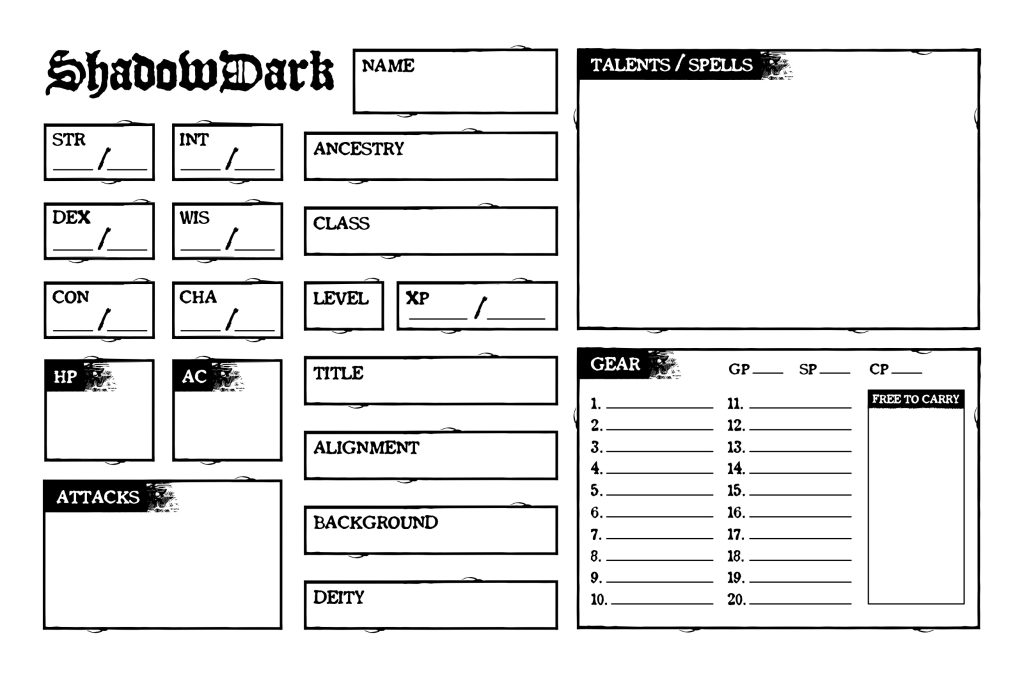
Shadowdark RPG Character Sheet
Dwarf
Elf
Goblin
Half-Orc
Halfling
Human
The four core classes are available:
Fighter
Priest
Thief
Wizard
There are no ancestry or class restrictions. Any ancestry can be any class, the same open approach used in 5e rather than the restricted or race-as-class models used in AD&D, Basic D&D, and Old-School Essentials.
Level cap is 10, the lowest of any edition in this series. This is well below AD&D’s near-unlimited human progression, Basic D&D’s 1-3 range within its own booklet, and 5e’s cap of 20.
Character creation uniquely supports an optional Level 0 funnel start, where new players begin as fragile ordinary folk with no class before surviving their way into an actual class at level 1.
Character advancement in Shadowdark also has some unique features. On leveling up, a character rolls their new class’s hit die, adding their Constitution bonus only once, at first level; every level after that adds the rolled hit die alone. They also roll on a class-specific Talent table that replaces the role feats and subclasses found in 5e. These talent rolls can grant ability score increases, combat bonuses, spellcasting improvements, or class-specific perks, and for wizards, a rare roll result even grants a random magic item outright.
This stands apart from AD&D, Basic D&D, and both 5e editions, which all let a player choose their advancement options, while Old-School Essentials falls somewhere in between depending on which classes are involved. Shadowdark instead leaves most of a character’s growth to the dice, trading build customization for the unpredictability that defines the rest of the game.
Given the tight four-class, six-ancestry scope and largely random character generation, creating a character here is faster than any other edition reviewed so far, comfortably under the 15-20 minutes estimated for Basic D&D, even for first-time players.
On the character sheet complexity scale, this edition sits at a 1, by far the easiest of our reviewed rules sets.
Shadowdark RPG Readability and Playability
The rulebook is built around two-page spreads that keep related rules physically close together, explicitly designed to minimize cross-referencing and keep the book out of the way once play starts.
A worked example of play is included, walking through an actual sequence of table events rather than describing rules in the abstract only.
The free Quickstart Set gives a group a complete, legal way to try the full game. It contains rules and an included adventure, for free, similar in spirit to Moldvay’s all-in-one approach and 5e’s free rules, though Shadowdark is built as a standalone starter product from the ground up rather than a trimmed slice of the core book.
Summary
Shadowdark takes the bones of B/X-style OSR play, tight classes, challenging resource management, fast character creation, and layers on a handful of ideas borrowed from 5e, ascending AC and advantage and disadvantage chief among them, while stripping away most of the character-build depth that defines the modern game. The result reads as neither a pure retroclone nor a 5e competitor in the direct sense, but a third option aimed at tables who want speed and lethality without relearning AD&D’s older, more idiosyncratic systems.
The Kickstarter numbers, the ENnie sweep, and a growing line of settings and supplements all point to real traction beyond the OSR’s usual audience. For groups exhausted by 5e’s character-build complexity but unwilling to take on AD&D’s discursive rulebook or Basic D&D’s dated presentation, Shadowdark occupies a real gap in the market, backed by a publisher still actively producing new material for it, and the sales figures suggest plenty of tables agree.
As an entry point, this is the fastest edition in this series to actually get a group playing, with the smallest class list, the lowest level cap, and the least character-build depth of anything reviewed here. That lack of complexity may read as reduced variety for players who prefer a long menu of options, however. What it asks of a new player up front is minimal. In essence, Shadowdark RPG gives you what you need to start playing D&D quickly and efficiently, then gets out of the way so you can focus on the game instead of the rules.
D&D Edition Review: 2020 Old-School Essentials Advanced Fantasy
This review covers Old-School Essentials Advanced Fantasy, published by Necrotic Gnome as a third-party retroclone built in the OSR tradition rather than an attempt to modernize or compete with 5e. Because of that lineage, comparisons here lean primarily on AD&D and Basic D&D rather than the two 5e reviews in this series. The game comes as two companion hardcovers, the Player’s Tome and the Referee’s Tome, both required for a complete game: the Player’s Tome alone is enough to join a game run by someone else, but the Referee’s Tome is required to run one.
History of Old-School Essentials
Old-School Essentials was designed by Gavin Norman and first published by Necrotic Gnome in 2019 as Classic Fantasy, a faithful restatement of the 1981 Moldvay/Cook Basic and Expert D&D rules. Advanced Fantasy followed as an expansion, adding character options and systems inspired by 1979 AD&D. The Player’s Tome and Referee’s Tome were first printed in November 2020, following a successful Kickstarter campaign.
Necrotic Gnome hasn’t released official sales figures, but demand has been strong. A 2021 restock of Advanced Fantasy stock reportedly sold out within days of going live, prompting a second print run.
As of this review, Necrotic Gnome has announced a 2026 update that will consolidate the separate Classic Fantasy and Advanced Fantasy lines into two definitive volumes, a Player’s Book and a Referee’s Book, planned for mid to late 2026. That update hadn’t released at the time of this review, so the Advanced Fantasy Player’s Tome and Referee’s Tome remain the current purchasable version, sold in print through Exalted Funeral and as PDF through DriveThruRPG, though physical stock has periodically sold out between print runs (further hinting at growing demand and popularity).
Playing the Game
Armor class is descending by default, the same convention used in AD&D and Basic D&D, paired with a THAC0-based attack system. Ascending armor class is offered as an optional rule for groups who prefer it.
Initiative is side-based, one d6 roll per side, matching Basic D&D exactly. There’s no individual initiative option in the core rules, unlike AD&D’s optional detailed system.
Player character death happens at 0 hit points by default, the same harsh standard as Basic D&D, with no negative hit point buffer built into the core rules the way AD&D offers as an option.
There’s no advantage or disadvantage mechanic. Bonuses and penalties are handled case by case, the same general approach used in both AD&D and Basic D&D.
Experience uses separate tables per class, the same structure found in both AD&D and Basic D&D.
OSE Player Characters
Advanced Fantasy supports two methods of character creation side by side. The default method follows Basic D&D’s race-as-class approach, where dwarf, elf, gnome, halfling, half-elf, half-orc, drow, duergar, and svirfneblin each function as their own class. An alternate method separates race and class entirely, closer to AD&D, letting a demi-human character choose freely from the available classes, with maximum level limits by race and class combination working much the way AD&D handles it.
Old-School Essentials Advanced Fantasy Character Sheet
Thirteen true classes are available:
Acrobat
Assassin
Barbarian
Bard
Cleric
Druid
Fighter
Illusionist
Knight
Magic-user
Paladin
Ranger
Thief
Nine demi-human races round out the option list:
Dwarf
Elf
Gnome
Halfling
Half-elf
Half-orc
Drow
Duergar
Svirfneblin
As in both AD&D and Basic, only humans face no restriction and can take any of the thirteen classes freely.
Human classes cap out at 14th level in the core rules, with an optional extension allowing advancement to 36th level. Demi-human race-classes cap out lower and don’t benefit from that extension unless a referee specifically allows it.
Demi-humans can multiclass across up to three classes at once, dividing experience among them, with no restriction on which classes can be combined, a simplification compared to AD&D’s specific approved combinations.
The Player’s Tome contains over 200 spells across the cleric, druid, illusionist, and magic-user lists, more than either AD&D’s roughly 150 or Basic D&D’s 44. Advanced Fantasy’s spell lists run the character’s full playable level range rather than being capped to the first few levels the way Moldvay’s Basic booklet was.
Character creation time is slightly faster than AD&D, in large part due to the more concise and logically organized presentation in OSE’s Player’s Tome. It provides two available creation methods and the multiclassing option, taking a first-time player roughly 30-40 minutes to generate a first-level character.
On the character sheet complexity scale, this sits at a 3. The presentation is cleaner than AD&D thanks to consolidated tables and better cross-referencing, but the number of race and class combinations, saving throw categories, and optional systems keeps it well above Basic D&D’s 2.
Advanced Fantasy Readability and Playability
Both tomes are known in the OSR community for clean, modern layout, addressing a specific, often-cited complaint about the original 1981 Basic/Expert rules: that building something as simple as an elf character required flipping between four different pages of the original booklet just to gather the basic rules for that character. Old-School Essentials was designed from the ground up to fix that kind of organizational sprawl, with useful tables, cross-references, and indexing throughout both tomes.
Neither the Player’s or Referee’s tome includes a narrative example-of-play walkthrough in the style of Moldvay’s Basic Set. Instead, both rely on clear reference formatting and worked rules examples rather than a story-driven sample session.
No free legal PDF of either tome is available. Necrotic Gnome does host a free official System Reference Document online, covering core B/X-derived rules such as combat, spellcasting, and character advancement, though it reflects the core Classic Fantasy ruleset rather than the full Advanced Fantasy race and class expansions.
Summary
Old-School Essentials Advanced Fantasy sits mechanically between Basic D&D and AD&D. It’s built on B/X’s cleaner underlying chassis but imports AD&D’s larger race and class roster, its demi-human level limits, and its two-book player and referee split, rather than Basic D&D’s single all-in-one booklet.
For a group that wants AD&D’s breadth of character options in a logically structured format but without AD&D’s discursive and long-winded writing style, this is a strong fit. The two available character creation methods also let a table choose how much of AD&D’s added complexity it actually wants, race-as-class for something closer to Basic D&D’s simplicity, or separate race and class for something closer to AD&D’s depth.
As an entry point, this is more organized than either 1970s or 1980s-era book it draws from, but the sheer number of race and class combinations and optional systems still asks more of a new player than Basic D&D’s tight four-class scope.
This review covers the 2024 revised core rules for 5th edition Dungeons & Dragons, published by Wizards of the Coast. Although many players refer to this as 5.5e, Wizards presents this as a revision of 5th edition rather than an officially new numbered edition, and it replaced the 2014 core books as the current product line while remaining largely compatible with them.
History of 5e (2024)
The revision was developed through the One D&D public playtest process, run through the Unearthed Arcana series across 2022 and 2023, gathering community feedback accumulated over the decade since the 2014 rules launched. Jeremy Crawford served as lead rules designer, the same role he held on the 2014 Player’s Handbook.
Release happened in stages, similar to 2014. The Player’s Handbook came first, releasing September 17, 2024, with early access to Local Game Stores on September 3 and staggered early access on D&D Beyond depending on subscription tier. The Dungeon Master’s Guide and a companion DM screen followed on November 12, 2024. The Monster Manual closed out the trilogy on February 18, 2025, still branded the “2024 Monster Manual” despite its actual release date falling in the following year.
Page counts grew across the board. The Player’s Handbook runs 384 pages, the largest in D&D’s history and up from 320 pages in 2014. The Monster Manual also grew to 384 pages, up from 352, and now contains more than 500 monsters, over 75 of them new.
Wizards of the Coast has stated that the 2024 Player’s Handbook printed three times as many copies as the 2014 Player’s Handbook’s initial run, and called it the fastest-selling D&D book in the game’s 50-year history. That framing has been disputed. Nielsen BookScan tracking of US physical retail sales showed the 2024 Player’s Handbook selling around 3,773 copies in its first week, compared to roughly 22,000 for the 2014 Player’s Handbook’s first week, suggesting the “fastest-selling” claim leans heavily on digital sales through D&D Beyond rather than physical retail. No independent lifetime sales total is available yet, since the book remains current.
Unlike the earlier editions covered in this series, this is the current, in-print product line, available new through retailers, Wizards of the Coast directly, and D&D Beyond.
Playing the Game
Armor class remains ascending, unchanged from 2014’s approach and still the opposite convention from AD&D and Basic D&D’s descending AC.
Initiative is still rolled individually, a d20 plus Dexterity modifier, the same as 2014.
Player character death still works through death saving throws, and this mechanic is unchanged from 2014: three net successes stabilize at 0 hit points, three net failures mean death, a natural 1 counts as two failures, and a natural 20 immediately restores 1 hit point and consciousness. Taking damage at 0 hit points still counts as an automatic failure, two on a critical hit, with instant death if that damage alone equals or exceeds the character’s hit point maximum.
Weapon Mastery is the biggest new combat mechanic introduced in this revision. Barbarians, Fighters, Monks, Paladins, Rangers, and Rogues, the classes most reliant on weapons, gain access to special properties tied to specific weapons, such as Cleave (hitting a second adjacent target after felling an enemy) or Vex (gaining advantage on your next attack against a target you’ve already hit). This system didn’t exist in 2014.
Experience still uses a single unified table shared by every class, unchanged from 2014, and the Dungeon Master’s Guide still offers a milestone-based alternative.
Advantage and disadvantage remain a key resolution mechanic, unchanged from 2014, and still the biggest structural difference from the situational modifiers used in AD&D and Basic D&D.
5e Player Characters
Species, the term now used in place of 2014’s “races,” number 10 in the core Player’s Handbook:
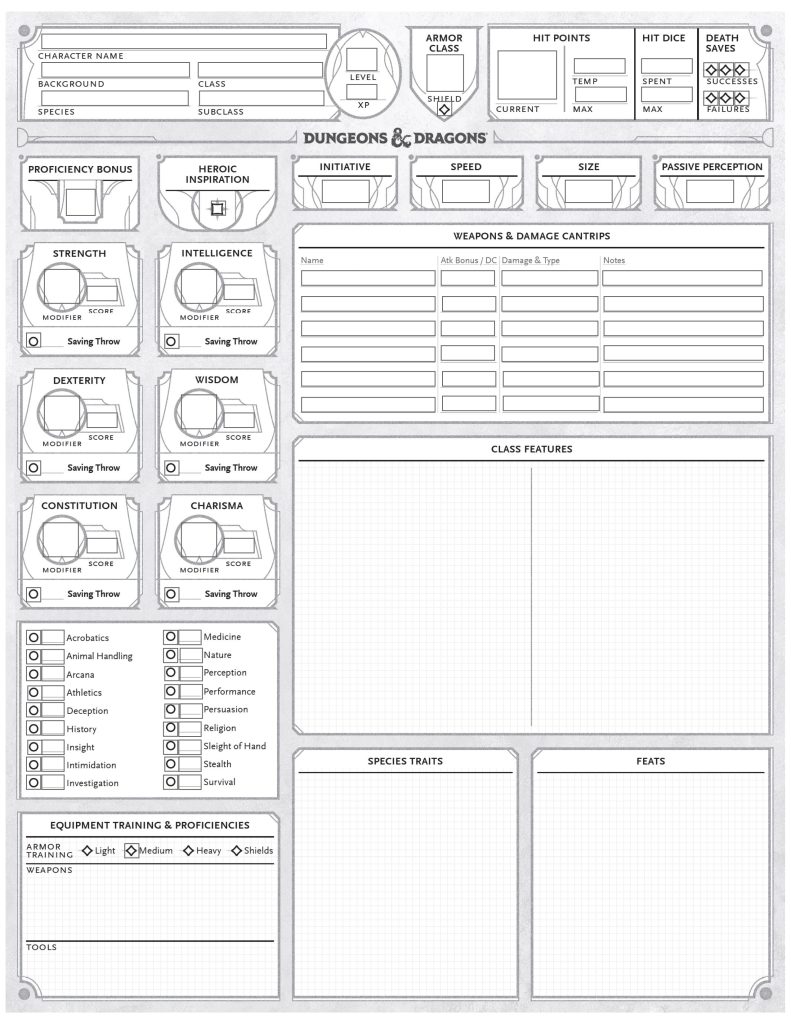
2024 5e Character Sheet
Aasimar
Dragonborn
Dwarf
Elf
Gnome
Goliath
Halfling
Human
Orc
Tiefling
Half-Elf and Half-Orc, both present in 2014, were dropped. Aasimar, Goliath, and Orc, all previously available only in supplement books, were added as core options.
Subraces have been eliminated entirely. No species offers a subrace choice anymore, a departure from 2014’s dwarf, elf, gnome, and halfling subrace options. Ability score increases have also moved away from species entirely. In 2014, a dwarf character always received the same ability score bonus regardless of class. In 2024, ability score increases come from the chosen background instead, so two dwarves with different backgrounds can start with entirely different ability scores.
Sixteen backgrounds are available, each granting a specific Origin feat, ability score increases, skill proficiencies, a tool proficiency, and starting equipment. This is a new structural role for backgrounds compared to 2014, where they mainly provided roleplaying flavor and skill proficiencies without feats or ability scores attached.
Seventy-five feats are available in total, including a new top tier called Epic Boon feats, reserved for high-level characters and offering some of the most powerful options in the book. Feats received far more emphasis structurally in this revision than in 2014, where they were an optional rule rather than a built-in part of character creation.
Twelve classes remain available, unchanged from 2014:
Barbarian
Bard
Cleric
Druid
Fighter
Monk
Paladin
Ranger
Rogue
Sorcerer
Warlock
Wizard
There are still no race or class restrictions of any kind, unchanged from 2014 and still a shared departure from both AD&D and Basic D&D.
Subclass selection is now standardized to level 3 for every class, a change from 2014, where selection ranged anywhere from level 1 to level 3 depending on the class. There are 48 total subclasses, four per class, a more even distribution than 2014’s lopsided norm of 2 or 3 per class, with Cleric at 7 and Wizard at 8. Some 2014 subclasses, three Cleric domains and four Wizard schools among them, were cut from this core book to make room for the standardized four-per-class format, though they remain usable alongside the new rules through the older books.
Level cap remains 20 across every class, with no race-based ceiling, unchanged from 2014.
The Player’s Handbook contains nearly 400 spells total, up from 361 in 2014, combining revised spells pulled from the 2014 Player’s Handbook, Xanathar’s Guide to Everything, and Tasha’s Cauldron of Everything, along with a small number of entirely new spells.
Character creation and advancement carry more real complexity in 2024 than in 2014, even though the book itself is organized to be easier to learn from. Weapon Mastery, a mandatory and more structured feat system, and the shift of ability scores from species to background all introduce interactions a 2014 character build never had to account for. A first-time player still needs roughly the same 30-45 minutes with a DM’s assistance to finish a first-level character (much longer if learning on their own), but leveling up and optimizing a build afterward asks more of the player than 2014 did.
On the character sheet complexity scale, this edition moves up to a 5, a step above 2014’s 4. The improved layout makes rules easier to find, but the system a player actually has to track and apply has grown rather than simplified. Of every ruleset in this series still available for purchase today, official or third-party, this edition’s character creation and advancement is the most complex.
5e D&D Readability and Playability
The 2024 Player’s Handbook is written and organized to read better for a brand new player than the 2014 book. It includes a fuller step-by-step walkthrough of an actual turn of play early on, more numerous example call-out boxes throughout the combat and spellcasting sections, and an alphabetized rules glossary, a reference tool the 2014 book never had.
A free version of the rules, called the D&D Free Rules rather than Basic Rules, launched alongside early access on September 3, 2024, hosted on the D&D Beyond website rather than distributed as a standalone downloadable PDF the way the 2014 Basic Rules were. It initially covered four classes (Cleric, Fighter, Rogue, and Wizard), four species (Dwarf, Elf, Halfling, and Human), four backgrounds, and a trimmed spell and monster selection. By early 2025, it had expanded to include all 12 core classes, each with one subclass, though the full 48-subclass, 10-species range still requires the paid core book.
Summary
This revision keeps the core structure of 2014 fifth edition intact while addressing some of its rougher edges. Weapon Mastery gives martial classes more to do turn to turn, subclass timing is standardized across every class instead of varying by 1 to 3 levels, and feats and backgrounds now play a defined structural role in character creation rather than sitting off to the side as optional or purely flavorful choices.
From the Dungeon Master’s side, this book is organized to be easier to reference at the table, with the added rules glossary being the clearest improvement over 2014 in that respect. The core teaching challenge doesn’t change much: Cleric and Wizard still carry more built-in subclass depth than the other ten classes, even after the standardization to four subclasses apiece.
As an entry point to tabletop roleplaying, this edition holds the same basic position 2014 did relative to AD&D and Basic D&D, with no race or class restrictions, advantage and disadvantage instead of a long list of situational modifiers, and a single XP table for every class. The free online rules now cover more ground than 2014’s downloadable Basic Rules did at launch, though a first-time player working through character creation alone will find even more decisions to make than they would have in 2014.
There’s a philosophy some DMs hold that the rules should get out of the way so the table can focus on the game itself. Of every ruleset currently available today, this edition sits furthest from that ideal. The reorganized book, the added glossary, and the free online rules all make the system easier to learn about, but the system itself, once a group sits down to actually build and advance characters, asks more of the player at every stage than any other version reviewed here.
This review covers the 2014 core rules for 5th edition Dungeons & Dragons, as published by Wizards of the Coast. It does not cover the revised 2024 core rulebooks, which replaced this version as the current line.
History of 5e D&D
5th edition was developed under the name D&D Next, with a public playtest beginning May 24, 2012, that ran for roughly two years with around 175,000 volunteer participants before launch. Mike Mearls and Jeremy Crawford are credited as the edition’s lead designers, with Crawford specifically leading development of the Player’s Handbook.
The rollout happened in stages. A free Basic Rules PDF came first, on July 3, 2014, followed by the Starter Set (containing the adventure ‘Lost Mine of Phandelver’) on July 15 of that same year. The Player’s Handbook followed on August 19, the Monster Manual on September 30, and the Dungeon Master’s Guide closed out the year on December 9.
Wizards of the Coast has never released a single official lifetime print run figure for the Player’s Handbook. Third-party sales tracking through Nielsen BookScan recorded more than 1.56 million Player’s Handbook sales in the US alone by 2023, a figure that doesn’t include overseas sales, digital sales through D&D Beyond, or secondary market activity. By most public accounting, including a 2016 comparison from Mike Mearls stating that 5th edition’s lifetime Player’s Handbook sales had already surpassed the combined lifetime sales of the 3rd, 3.5, and 4th edition Player’s Handbooks, this is the best-selling edition of D&D to date.
The 2014 core books are no longer the current product line, having been replaced by a revised Player’s Handbook, Dungeon Master’s Guide, and Monster Manual in 2024, often referred to as 5.5e. Like AD&D and Basic D&D, the 2014 books can still be found through remaining retailer stock and the used market, and digital versions remain available through D&D Beyond.
Playing the Game
Armor class is ascending in this edition: the higher the number, the better protected the character, a departure from the descending AC convention used in AD&D and Basic D&D.
Initiative is rolled individually for each character, a d20 plus the character’s Dexterity modifier, rather than as a single roll per side. Monsters can have their initiative rolled individually by the DM, but it is more common for all monsters to act together based on a collective initiative roll.
Player character death works through death saving throws. At 0 hit points, a character falls unconscious and rolls an unmodified d20 at the start of each of their turns: three net successes stabilize them at 0 hit points, three net failures means death, a natural 1 counts as two failures, and a natural 20 brings the character up to 1 hit point and restores consciousness. Taking damage while already at 0 hit points counts as an automatic failure, two on a critical hit, and if that single instance of damage equals or exceeds the character’s hit point maximum, they die instantly instead of rolling.
Advantage and disadvantage are a key change in 5e compared to AD&D and Basic editions. Rolling two d20s and taking the higher or lower result, respectively, replaces the long list of individual situational bonuses and penalties found in AD&D and Basic D&D.
Character level advancement uses a single unified experience points table shared by every class, so a barbarian and a wizard need the same total XP to reach each level, unlike the class-specific tables used in both earlier editions covered in this series. The Dungeon Master’s Guide also offers a milestone-based alternative that skips XP tracking entirely, advancing characters at story beats instead.
Experience points are earned more heavily based on monsters slain or overcome, losing the 1 gp = 1 xp mechanic in older editions.
5e Player Characters
Nine playable races appear in the core Player’s Handbook:
5e (2014) Character Sheet
Human
Dwarf
Elf
Halfling
Dragonborn
Gnome
Half-Elf
Half-Orc
Tiefling
Several of these split further into subraces. Dwarves have hill and mountain variants, elves have high, wood, and dark (drow), gnomes have forest and rock varieties, and halflings offer lightfoot and stout variations.
Twelve classes are available:
Barbarian
Bard
Cleric
Druid
Fighter
Monk
Paladin
Ranger
Rogue*
Sorcerer
Warlock
Wizard
What was called a thief in AD&D and Basic editions has been renamed rogue in 5e.
There are no race or class restrictions of any kind in this edition. Any race can be any class, a deliberate break from earlier editions covered in this series. This means a player rolling up a new character has a wide selection of race and class combinations to choose from. The variety goes up dramatically once characters reach third level.
Each class selects a subclass, though the number of options varies considerably in the core book. Clerics have 7 divine domains and Wizards have 8 arcane schools, while every other class has just 2 or 3 subclass choices, an imbalance later addressed through supplement books.
All characters cap out at level 20 across every class, with no race-based ceilings.
The Player’s Handbook contains 361 spells total across every spellcasting class, roughly two and a half times AD&D’s combined spell count and far beyond the much smaller list in Basic D&D.
Character creation involves significantly more decision points than either earlier edition. Race, class, subclass, background, skills, equipment, and spells for casters all require a choice. None of those choices restrict each other, though, unlike AD&D’s race and class rules. To create a first-level character, a first-time player typically needs 30-45 minutes with DM guidance, or significantly longer if figuring it out on their own. It is common for players to use online tools to expedite this process, especially when generating characters that start higher than level 1.
On the character sheet complexity scale, this edition sits at a 4. Skills, saving throw proficiencies, and spell slots for casters add real bookkeeping, with a fair bit of time spent calculating modifiers based on core stat values and modifiers determined by which class and race were selected.
5e Readability and Playability
The Player’s Handbook is 320 pages long and reads in a more conversational, tutorial style than either earlier edition, using sidebars, quick-reference tables, and short example call-outs to explain rules as they’re introduced rather than assuming prior familiarity with the game.
Chapter 1 walks a new player through building a character step by step alongside a running example. Combat and other rules sections use brief illustrative examples rather than a full narrated session. Color artwork is included throughout all three core rulebooks.
A free Basic Rules PDF has been available directly from Wizards of the Coast since July 2014. It includes one race option per race entry, four core classes (cleric, fighter, rogue, and wizard), and a trimmed spell and monster selection, enough to build characters and run a complete game without buying anything.
Summary
5th edition removes most of the friction that makes AD&D demanding for a new player, but adds significant choice complexity during character creation and subsequent play compared to Basic D&D.
Compared to AD&D, there are no race or class restrictions to check, advantage and disadvantage replace a long list of situational modifiers, and a single XP table applies to every class. The tradeoff is a wider set of decisions to make during character creation, since race, class, subclass, background, and equipment are all separate choices with no built-in restrictions steering a new player toward simpler combinations. Leveling up introduces additional choices for the player.
From the Dungeon Master’s side, this edition is built to run with less table-side calculation than AD&D required, and the free Basic Rules make it possible to start a group without any purchase at all. The tradeoff for the DM shows up in subclass balance rather than rules complexity, with Cleric and Wizard offering considerably more depth than the other ten classes right out of the core book.
As an entry point to tabletop roleplaying, this is a reasonably approachable edition to play, but is very complex for character creation. The free rules, the removal of race and class restrictions, and the advantage and disadvantage system all lower the barrier for a first-time player, even as the sheer number of character build options can feel like its own kind of overwhelming at the table.
This review covers the 1981 D&D Basic Set as edited by Tom Moldvay, the second edition of Basic D&D following J. Eric Holmes’s 1977 original and preceding Frank Mentzer’s 1983 revision. Only the Moldvay edition is addressed here.
Basic D&D History
The 1981 Basic Set was published by TSR, edited by Tom Moldvay, and released in January of that year. It came as a boxed set containing a 64-page rulebook with a red border and cover art by Erol Otus, six polyhedral dice, a marking crayon (since the dice weren’t pre-filled with paint), and, in early print runs, the adventure module B2: The Keep on the Borderlands, a revised version of Gary Gygax’s module included to give new groups something to play right out of the box.
TSR never released official print run figures for the rulebook itself. It is estimated that more than 1 million copies of B2, The Keep on the Borderlands, were printed, making it arguably the best-selling module in D&D history, though that distinction may since have been challenged by Wizards of the Coast’s own Lost Mine of Phandelver.
Long out of print as a standalone product, the rulebook has since returned as an official Wizards of the Coast print-on-demand and PDF reprint through DriveThruRPG, alongside the companion Expert Set rulebook edited by David Cook and Steve Marsh. Used copies of the original boxed set are also available through the secondhand market.
Playing the Game
Basic D&D uses descending armor class, the same convention used in AD&D: 10 is unarmored, and better protection lowers the number, down to -10 for the best protection.
Initiative is side-based only, one d6 roll per side, with no individual or alternate system offered as an option.
Player character death is absolute. Reaching 0 hit points means the character is dead, no exceptions, a harsher standard than AD&D’s unconscious-at-zero, dead-at-negative-ten rule. This has led Basic D&D to have a reputation of being deadly, especially to low-level characters.
Further adding to its deadly reputation is that failing a poison saving throw will kill any character, regardless of level.
There’s no advantage or disadvantage mechanic. Bonuses and penalties are handled case by case as situational modifiers, the same general approach AD&D uses.
Experience tables differ by class, and gold recovered from treasure converts directly into experience points, matching the same underlying structure found in AD&D.
The weapons player characters use all do 1d6 damage by default but rules listed as optional provide different damage by weapon type.
Player Characters in Basic D&D
The defining change from AD&D is race-as-class. Humans choose freely among four classes: cleric, fighter, magic-user, and thief. Every non-human character is simply “a dwarf,” “an elf,” or “a halfling” instead, with race and class collapsed into a single choice that carries its own fixed set of abilities.
Basic D&D Character Sheet
Human (Cleric, Fighter, Magic-User, or Thief)
Dwarf
Elf
Halfling
Dwarves are essentially fighters, elves are fighter/magic-users, and halflings are thieves.
This rulebook covers character levels 1-3 only. Higher levels required the separately sold Expert Set. Demi-human level caps do exist for dwarves, elves, and halflings, but they don’t come into play within this book’s level range.
Spell lists are proportionally small compared to AD&D. Magic-users, along with elves who draw from the same list, have access to 12 spells at each of the first three spell levels, 36 spells total within this booklet. Clerics receive no spells at all until level 2. Even then, since this book only covers levels 1 through 3, clerics never advance past first-level spells, a list of 8 total. Combined, that comes to roughly 44 spells covered here, well short of AD&D’s roughly 150.
Character creation moves faster than AD&D. Race-as-class removes a layer of restriction-checking, and a first-level character can typically be created in 15-20 minutes.
On the character sheet complexity scale, this edition sits at a 2. Saving throw categories and class abilities still need tracking, but the simplified race and class structure removes much of the bookkeeping AD&D requires.
Basic D&D Readability and Playability
Moldvay’s writing style, unlike Gary Gygax’s, is easier to digest and assumes the reader has no prior experience with D&D or role-playing games in general.
The booklet is laid out in numbered parts covering introduction, character classes, spells, the adventure, encounters and combat, monsters, treasure, and information for the Dungeon Master, each section self-contained and easy to locate.
Two examples of play walk the reader through actual table procedures. Both use a sample party of Morgan Ironwolf the fighter, Silverleaf the elf, Fredrik the dwarf, and Sister Rebecca the cleric, later joined by Black Dougal the thief. The second walk-through follows that same party through a combat encounter step by step.
The rulebook includes a step-by-step walkthrough for building the beginning of a sample dungeon level, intended to teach a new DM how to design one, though it doesn’t extend to a full ready-to-run adventure. The Keep on the Borderlands, included separately with the boxed set, served that role instead.
No separate basic or simplified version of this specific rulebook exists, since the Basic Set already occupies that role within the wider Basic and Expert product line. A free legal PDF isn’t available, though an official paid PDF and a physical print-on-demand reprint are both available through DriveThruRPG.
Summary
This edition is far more approachable than AD&D for someone brand new to tabletop gaming, which was its purpose. It’s a genuine all-in-one booklet, covering everything a player or DM needs for character levels 1-3, including a bestiary of over 100 monsters, so nothing else has to be purchased just to start playing. Race-as-class and the smaller spell lists trade some depth for a much shorter path to a finished character and a table that’s ready to play.
From the DM’s side, having player rules, monster stats, treasure guidelines, and dungeon-building instruction inside one 64-page booklet, backed by two fully worked examples of play and a complete ready-to-run adventure module, makes this an easier edition to prep and run than AD&D’s three separate, more idiosyncratically written books.
As a starting point for someone new to the hobby, this edition holds up well, teaching by direct example rather than by reference alone. Players coming from later editions with a wider array of character options may find the four available classes and the level 1 through 3 ceiling limiting, though that ceiling was always meant to be temporary, with the Expert Set built to pick up right where this book leaves off.
Cover, Advanced Dungeons & Dragons Player Handbook
This review covers Advanced Dungeons & Dragons, AD&D, or 1e as it’s sometimes called, based on a set of three core rulebooks published incrementally from 1977 to 1979.
The History of AD&D
Advanced Dungeons & Dragons, or AD&D, was published by TSR out of Lake Geneva, Wisconsin, with Gary Gygax credited as the primary author across all three core books. The Monster Manual came first in 1977, followed by the Player’s Handbook in 1978, and the Dungeon Masters Guide closed out the set in 1979.
Original prices ran close to $9.95 for the Player’s Handbook and the Monster Manual, with the Dungeon Masters Guide priced higher, around $15, reflecting its size and its role as a hardcover reference aimed at the person running the game.
TSR never released official print run figures for these three books, at least none that survive in any accessible public record. What is well documented is that AD&D was the dominant tabletop RPG through the early and mid 1980s, a period during which TSR held the largest market share in the hobby.
None of the three core books are currently in print. Used copies can sometimes be purchased at game stores or conventions, while online marketplaces like eBay are a common source. As with any used book, condition varies by copy. Wizards of the Coast, the current publisher of official D&D, has also released PDF and premium reprint hardcover versions of all three books through DriveThruRPG, making a clean digital or physical copy available through official channels as well.
Playing AD&D
AD&D uses what’s called “descending” armor class. 10 is the worst and most vulnerable, essentially a person without any armor. 0 is better, and -10 is best. Later editions use ascending armor class where the higher the AC, the more protected the character or monster is.
Initiative defaults to a group roll, one d6 per side, rather than a roll per character. The Dungeon Masters Guide also offers an optional, more detailed system that factors in individual initiative, weapon speed, and spell casting time. Using those rules as written (weapon speed, etc.) quickly makes AD&D the most complex official D&D game rules set for how to handle initiative.
Player character (PC) death is unforgiving by modern standards. Reaching zero hit points is generally treated as death, but the rules-as-written specified that the character becomes unconscious at 0 hit points, and dead at -10. Even with that option in use, low level characters carry very few hit points, and a bad string of rolls can end a character in a single encounter.
Unlike newer editions, there’s no advantage or disadvantage mechanic in AD&D. Bonuses and penalties are handled case by case, tied to specific situations such as surprise or high ground, rather than through one unified system applied across all rolls.
Experience and leveling up follow separate tables for each class, so different classes advance at different rates for the same amount of earned experience. For example, thieves only need 1250 experience points to go from level 1 to level 2, but paladins need 2,750. Recovered gold converts directly into experience points, where 1 gold piece equivalent in treasure grants 1 experience point. This is a mechanic later editions dropped, making treasure a direct source of character advancement alongside combat and problem solving.
AD&D Player Characters
AD&D used the term “race” to describe the human and demi-human beings a player can use for their character, of which there were seven available:
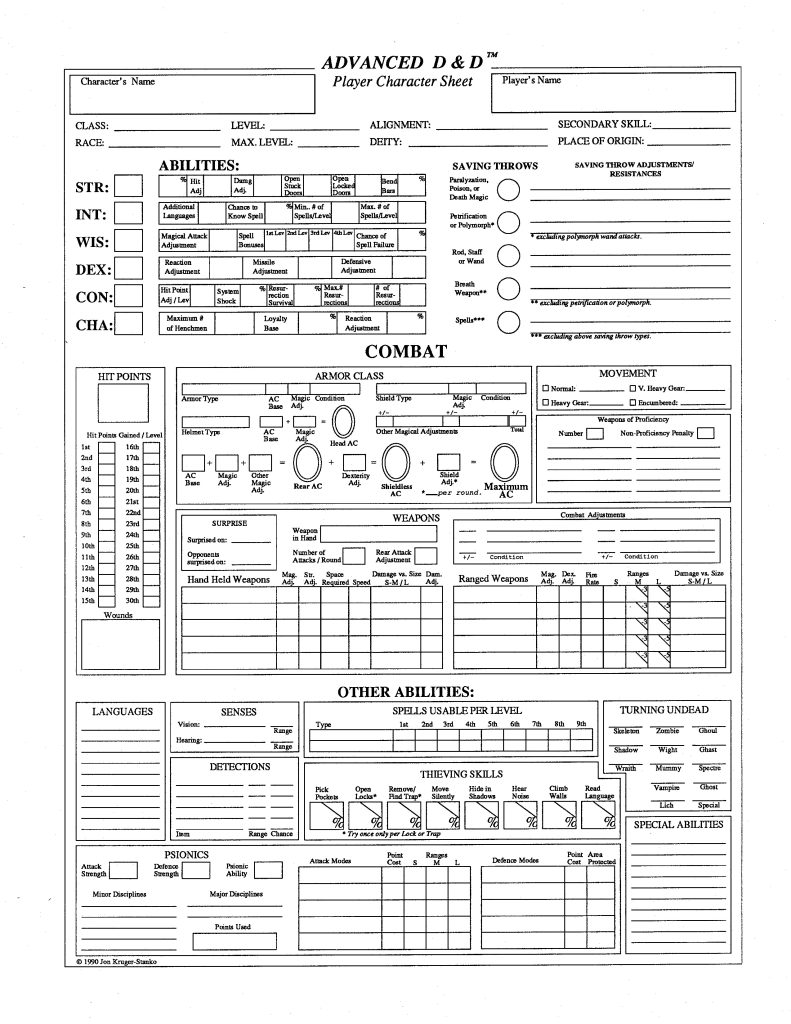
Advanced D&D Character Sheet
Human
Dwarf
Elf
Gnome
Half-elf
Halfling
Half-orc
For those races, there were eleven classes available:
Cleric
Druid
Fighter
Paladin
Ranger
Magic-user
Illusionist
Thief
Assassin
Monk
Bard.
Bards in AD&D is a distinct case, because it required the PC to be a fighter for several levels, switch to a thief for more levels, and only then could they switch to being a first-level bard.
Race and class are closely linked. Humans face no restrictions and can be any class. Every other race is barred from several classes outright, and the ones they can take often come with a level cap that humans don’t have. High enough ability scores can raise or occasionally remove some of those caps, but as a general rule, non-human races trade a lower advancement ceiling in exchange for other racial benefits such as improved saving throws or infravision.
Spellcasters draw from two separate lists, one for clerics spanning levels 1-7, and one for magic-users spanning levels 1-9. Combined, the two lists total roughly 150 spells.
AD&D also had optional rules for psionics, which granted some rare characters abilities akin to spells that are ‘cast’ using just their mind.
Creating a first-level AD&D character typically takes thirty to forty five minutes, accounting for rolling ability scores, determining eligible race and class combinations, tracking starting gold, and selecting equipment.
On the character sheet complexity scale, AD&D sits at a 5 on a 1-5 scale, although there are several items on an AD&D character sheet, such as weapon speed factors, that are optional. Skipping those makes it a 4 out of 5 for complexity. Race and class restrictions, separate saving throw categories by class and level, and a high number of situational modifiers all contribute to the load a player has to track.
AD&D Readability and Playability
Gygax’s writing is professorial and dense, often shifting from rules explanation into extended personal commentary on how the game should be run, particularly in the Dungeon Masters Guide.
Examples of actual play are limited. The Player’s Handbook has none, and the Dungeon Masters Guide offers a small number of sample combat rounds, considerably fewer than later rulebooks that rely more heavily on worked examples to teach new players.
No basic or simplified version of AD&D exists. TSR’s separate Basic Set, edited by Holmes and then later by Moldvay and then Mentzer, served as an entry point for new players at the time, but that product falls outside the scope of this review. Access to the AD&D core rules today requires either a used physical copy or the officially licensed PDF or reprint on the used book market.
Summary
AD&D places significant demands on a new player before it becomes intuitive, and it’s not a good choice for those brand new to the game without experienced DMs and other players in the group. Race and class restrictions, descending armor class, and a large collection of reference tables all require upfront learning, and the Dungeon Masters Guide reads more like an extended set of design opinions than a straightforward reference manual. For someone with no prior background in tabletop games, the learning curve is steep.
From the Dungeon Master’s side, the system is versatile and holds together once its individual pieces are learned, rewarding careful reading and a willingness to make rulings where the text is ambiguous or silent.
Approachability today depends largely on the reason for picking it up. For historical interest or an understanding of the mechanical foundations of the hobby, it’s an enjoyable edition. For an easy first introduction to tabletop roleplaying, other systems are better choices.
Most of the advice given to DMs says to reveal lore and plot hooks and other details a little bit at a time. You let the players discover these things as they go. I’ve given this advice myself in other articles and videos on my YouTube channel (@ruckerworks). But what if you lay it all out up front, sharing with the players the map and monsters and maybe even the traps?
Here’s why this approach can be a blast in your next D&D adventure.
A Real Scenario
A while back one session at the D&D game I run entailed the six players spending an hour and a half planning their guerilla attack on a horde of 60 hobgoblins encamped along a road. They were able to scout out the horde, determine their composition and likely armaments. The players also identified the location of their objective. They had to retrieve a magic item from the backpack of the hobgoblin captain, who as you can guess, was located in the center of the horde’s encampment.
There are two key elements to this adventure: First, the odds were steep. This was a very difficult challenge and the plan of attack would have to be perfect to prevent a TPK (total party kill). Second, the players had nearly full disclosure and understanding of what they were up against. They spent a lot of time gathering intelligence about the situation, and other than a few trivial details, I shared with them everything they investigated.
The actual guerilla attack went off perfectly. The players weighed their options based on everything they knew, chose the approach that had the best odds, and went for it. It was a very memorable session and the players still talk about it today, more than a year later.
Tricks to Full Disclosure Adventures
The point of the example of six players going against a horde of 60 hobgoblins reveals something profound. Hiding things from players, and letting them discover them as they go works as a device to keep the players engaged and interested. But, revealing up front nearly everything about an adventure can be fun, too.
There’s a few tricks to doing it successfully, though.
The first requirement is that the danger and risk level needs to be high. There needs to be a real challenge, often greater than when things are unknown. Second, and this is an important detail, the players will know most things with this approach but can’t know everything.
Make It Work
Here are some ways you can make this “full disclosure” method work.
First, determine your premise. What’s the goal of the adventure? Three potential ideas are a heist, where the party must infiltrate a known location and steal something valuable; a rescue, where the party sneaks into, you guessed it, a known location to rescue a comrade or some VIP; and third, a recovery mission. Perhaps the party was in a dungeon or castle or temple, got nearly all the way through it and mapped it out, but either lost something or have to go back to finish what they started.
What these all have in common is a known location, likely with a complete or nearly complete map. One exception to this might be a treasure room inside the dungeon. They have a suspicion of where it is likely located, based on well-mapped knowledge of what’s around it, but they didn’t quite find it specifically. Or maybe after exploring the whole dungeon, they found the door to the treasure room but couldn’t get in, so they went back to town, got what they needed, and are heading back. Except now there’s some new danger in their way.
Second, some details need to remain undiscovered. Perhaps that hobgoblin horde has an obvious spell-caster in their midst but the players don’t know if they are a priest or wizard type, and obviously don’t know what spells they can cast. The party should also have uncertainty about the relative strength of monsters. Yes, they know that beast guarding the treasure room door is a dragon, but they don’t know which dragon or how powerful it is.
Known Locations
One way you might combine the idea of a known location with the concept of discovering new things is to let the party obtain a map of a location they’ve never been to. The map is complete or nearly complete, but leaves some details out. For example, the party’s mission might be to visit abandoned ruins and return them to civilized ownership. Their research has provided access to a complete map of the location and its inner layout, but they have no idea what creatures have since occupied it.
That map may even indicate the presence of traps. But what it won’t reveal is how to disarm them.
A final discovery item will be treasure. The players learn that a treasure horde exists within the ruins, in one of two or three possible locations, and the rumors of what’s in that treasure have them salivating over it. But, they don’t know for sure the true extent of the treasure, which complicates their planning for how to get the treasure back to civilization. And, there might be a small surprise of what’s guarding the treasure.
Best Practices And When To Break Them
As a DM, there are multiple ways to provide an engaging experience for your players. Know the rules and best practices so you know when to break them. Revealing lore a little at a time is a best practice, but that doesn’t mean it’s the only way to have a fun game. Reveal a lot of lore, but leave out some details so there’s at least some uncertainty, while jacking up the danger level so that your players have something to plan around.
In my experience, I’ve seen these planning-type of adventures be a ton of fun for the players, as well as for me as I run the game. It’s fascinating to see what dangers the players take seriously and which ones they dismiss, or see the creative approaches they come up with to solve problems. It’s a blast, actually.
If you’re a Dungeon Master, you’ve got it pretty good when it comes to instruction and inspiration. There are YouTube channels, blogs, and whole podcasts dedicated to how to prep an adventure, how to run a session, how to build a campaign. That’s one of the things I try to help with here on Ruckerworks. The official rulebooks give you entire chapters walking you through adventure prep step by step, and the 2024 version of 5e from WotC does an especially good job of it.
If you’re a player, what’s actually out there to help you not just learn how to play, but how to play well?
Go look, and you’ll find the choices from WotC are thin. That’s a real gap, and it leaves the rest of us in the D&D content space on the hook to fill it in. In this article, I want to talk about why that gap between DM resources and player resources exists, and share two approaches that have actually helped new players get up to speed a bit quicker.
The Rulebook Gap Wizards of the Coast Left Open
When I first started playing D&D back in 1980, there was no YouTube or World Wide Web. You and your friends bought the books, or the basic set, sat down and figured it out together. If you were lucky, you found an existing group, or a DM who maybe had three sessions more experience than you did. That was the entire learning process.
Learning D&D back in the day was trial and error, like getting a bookshelf from IKEA with no instructions for how to assemble it.
There was no player education back then. There was barely any DM education either, other than the little bit tucked into the Basic Set’s rulebook. Everybody was figuring it out as they went.
Here’s what’s strange when you look at the situation today. DMs have an almost endless well of instruction available to them, while players get plenty of “here’s how to do it” content online, but it’s far less coherent. It tends to be specialized around a particular edition, or shaped heavily by the preferences and opinions of whoever’s making the video.
Learning 5th edition is admittedly a bit different than learning Shadowdark or Old-School Essentials, but the fundamentals are the same across all of them. I’m not talking about the syntax of one edition’s rules versus another. I’m talking about solid, instructional material on how to be a genuinely good player, something that holds up no matter which rule set you’re sitting down with.
The reason this gap exists for players is simple. The official Wizards rulebooks left a hole, and that hole is still there.
How I Learned D&D (Twice)
Back in 2016, when I started playing 5e, the first thing I did was buy the three core rulebooks and read them cover to cover. Keep in mind, at that point I’d already been playing D&D for over three decades. I went down to the local game shop for open-table night thinking I’d slot right into a group and play with the best of them.
I realized pretty quickly that despite having the fundamentals down, enough had changed that I still needed to brush up. I got up to speed at a decent pace, but only because I learned it the old-fashioned way.
I sat down with a DM and a group of players who already knew the game, and they walked me through it as we went. It was learning by example.
I still think that’s the best way to learn. But it comes with a caveat. You end up learning a style of play that mirrors that particular group, which isn’t a problem if you never plan to sit at anyone else’s table, but it’s worth knowing that’s what’s happening.
Teaching a Revolving Door of D&D Beginners
These days, my primary D&D experience is running the teen program at my local public library. I’m one of two DMs running biweekly games there, and about 98 percent of the kids who show up have never played before in their life.
In two years, I’ve had 21 different kiddos play D&D for the very first time at my table.
That means what constitutes a Session 0 in my group (it’s different; see below) usually eats the entire two-hour block. I’m not just rolling up characters with them. I’m teaching them, in real time, how to actually play the game. We cover what a DC check means, how armor class works, and what initiative is. We even go over table etiquette and the social expectations that a lot of us take for granted after years at the table. Even after all that, I’m still teaching them as we go, session after session.
That’s fine, and honestly it’s the best way I know to teach the game. But here’s the thing. If the official Player’s Handbook actually did its job, I wouldn’t need an entire two-hour block just to get new players to a point where they can play at a basic level.
Here’s why we don’t have a formal Session 0 in our group. My situation is complicated further because we don’t start fresh with everyone at once. We have an established group, and when one kid drops out, a new one takes their seat. The rest of the table has some experience but is still learning the ropes themselves, so I end up integrating a total newcomer while the actual game is already in motion.
If new players showed up with even a little decent training already under their belt, my job would be a lot easier.
D&D is Simple to Learn But Hard to Master
The fundamentals of playing D&D are genuinely simple, and they take about a minute to explain.
The DM tells you what you see. You tell the DM what you do. The DM tells you what happens. Rinse and repeat. That’s it. You’re playing D&D.
Playing it well is an entirely different matter, and that can take months or years. What counts as good play is also genuinely subjective. What one table finds fun and engaging, another table might find slow or pointless. There’s no single correct way to play (that’s a good thing), which is exactly why there are so many videos online about how to play D&D that don’t agree with each other. Learning to play D&D well is a bigger challenge than most people realize, precisely because there’s no consensus on what “well” even means.
Why Online D&D Instruction Isn’t Enough
This is the actual point of this article. The official D&D rulebooks don’t adequately prepare new players to become effective, confident players at the table. Not because it’s impossible to teach. WotC just never really tried.
There’s a mountain of content online trying to fill that space, but most of it comes with a catch. It’s somebody’s personal brand of how to play D&D, or a claim that one edition is the right one, or one play style is the best way to do it. A new player wading through all of that isn’t getting neutral instruction. They’re getting someone’s opinion dressed up as an implied best practice.
Two Ways To Learn D&D That Have Actually Worked For Me
I can tell you what’s worked for me, both as that brand new player back in 1980 and as the guy teaching a constantly rotating group of teenagers experiencing the game for the very first time.
Reading a transcript of actual play.
This is a no-pressure way to get exposed to the game. The old Basic Set rulebook included two of these transcripts, and they were fantastic. A new player could sit with one and absorb the rhythm of the game before ever picking up dice. When I wrote Ashes of Isar, my own WWII espionage RPG, I made sure to include a sample play transcript in the rulebook for the same reason.
You might ask why not just watch an actual game on YouTube instead. That can work, but something subtle happens when you learn that way. You get exposed to the mechanics, but it’s conveyed in a way that implies a particular social style of play is the way the game works. I’ve noticed that teens who show up to the library’s games after watching actual play online arrive with a strong sense of how the game should feel or how everyone should behave, but very little understanding of the mechanics and almost no sense of how to actually play well. It’s an odd phenomenon I haven’t fully figured out.
I had one teen show up thrilled about D&D because he’d seen it on the hit Netflix show, Stranger Things. He figured our sessions would go exactly like the show, and told me flat out that the character Eddie was the greatest DM who ever lived. No pressure. What threw him, though, was realizing our game wasn’t connected to the show at all. He genuinely thought every D&D game followed the same plot and the same events.
Running a sample combat before the real thing.
A short demo session, especially a sample combat encounter, is one of the most useful parts of an expanded Session 0. Combat is usually the most overwhelming part of the game for a brand new player, so walking through one together, with low stakes, before the real game starts, does more good than any amount of explaining the rules out loud. With new players joining an existing group mid-campaign, this gets trickier to pull off, but I try to carve out ten or fifteen minutes of practice play where damage and death don’t count, with the veteran players joining in, before we dive into the real session.
I’ve also tried writing up a tutorial handout for the kids, and it never worked. To them it felt like homework. Written cheat sheets have occasionally helped adult players, mostly for summarizing character creation options, but they’ve never done much for teaching actual play.
What’s Worked Doesn’t Mean What’s Required
Both of these, written transcripts and demo play inside an expanded Session 0, have worked for me. That doesn’t mean they’re the only way to do it. Every table is different, and every group of players is different. But if you’re a DM bringing in new players and you’re waiting for the rulebook to do that teaching for you, you’ll be waiting a long time.
If you’re brand new to the game yourself, the Player’s Handbook will do a fine job walking you through character creation. Just don’t expect it to teach you how to actually play. That part is still on the rest of us. And be aware that watching live-play sessions on YouTube should be considered entertainment more than education.