

This review covers Advanced Dungeons & Dragons, AD&D, or 1e as it’s sometimes called, based on a set of three core rulebooks published incrementally from 1977 to 1979.
The History of AD&D
Advanced Dungeons & Dragons, or AD&D, was published by TSR out of Lake Geneva, Wisconsin, with Gary Gygax credited as the primary author across all three core books. The Monster Manual came first in 1977, followed by the Player’s Handbook in 1978, and the Dungeon Masters Guide closed out the set in 1979.
Original prices ran close to $9.95 for the Player’s Handbook and the Monster Manual, with the Dungeon Masters Guide priced higher, around $15, reflecting its size and its role as a hardcover reference aimed at the person running the game.
TSR never released official print run figures for these three books, at least none that survive in any accessible public record. What is well documented is that AD&D was the dominant tabletop RPG through the early and mid 1980s, a period during which TSR held the largest market share in the hobby.
None of the three core books are currently in print. Used copies can sometimes be purchased at game stores or conventions, while online marketplaces like eBay are a common source. As with any used book, condition varies by copy. Wizards of the Coast, the current publisher of official D&D, has also released PDF and premium reprint hardcover versions of all three books through DriveThruRPG, making a clean digital or physical copy available through official channels as well.
Playing AD&D
AD&D uses what’s called “descending” armor class. 10 is the worst and most vulnerable, essentially a person without any armor. 0 is better, and -10 is best. Later editions use ascending armor class where the higher the AC, the more protected the character or monster is.
Initiative defaults to a group roll, one d6 per side, rather than a roll per character. The Dungeon Masters Guide also offers an optional, more detailed system that factors in individual initiative, weapon speed, and spell casting time. Using those rules as written (weapon speed, etc.) quickly makes AD&D the most complex official D&D game rules set for how to handle initiative.
Player character (PC) death is unforgiving by modern standards. Reaching zero hit points is generally treated as death, but the rules-as-written specified that the character becomes unconscious at 0 hit points, and dead at -10. Even with that option in use, low level characters carry very few hit points, and a bad string of rolls can end a character in a single encounter.
Unlike newer editions, there’s no advantage or disadvantage mechanic in AD&D. Bonuses and penalties are handled case by case, tied to specific situations such as surprise or high ground, rather than through one unified system applied across all rolls.
Experience and leveling up follow separate tables for each class, so different classes advance at different rates for the same amount of earned experience. For example, thieves only need 1250 experience points to go from level 1 to level 2, but paladins need 2,750. Recovered gold converts directly into experience points, where 1 gold piece equivalent in treasure grants 1 experience point. This is a mechanic later editions dropped, making treasure a direct source of character advancement alongside combat and problem solving.
AD&D Player Characters
AD&D used the term “race” to describe the human and demi-human beings a player can use for their character, of which there were seven available:
- Human
- Dwarf
- Elf
- Gnome
- Half-elf
- Halfling
- Half-orc
For those races, there were eleven classes available:
- Cleric
- Druid
- Fighter
- Paladin
- Ranger
- Magic-user
- Illusionist
- Thief
- Assassin
- Monk
- Bard.
Bards in AD&D is a distinct case, because it required the PC to be a fighter for several levels, switch to a thief for more levels, and only then could they switch to being a first-level bard.
Race and class are closely linked. Humans face no restrictions and can be any class. Every other race is barred from several classes outright, and the ones they can take often come with a level cap that humans don’t have. High enough ability scores can raise or occasionally remove some of those caps, but as a general rule, non-human races trade a lower advancement ceiling in exchange for other racial benefits such as improved saving throws or infravision.
Spellcasters draw from two separate lists, one for clerics spanning levels 1-7, and one for magic-users spanning levels 1-9. Combined, the two lists total roughly 150 spells.
AD&D also had optional rules for psionics, which granted some rare characters abilities akin to spells that are ‘cast’ using just their mind.
Creating a first-level AD&D character typically takes thirty to forty five minutes, accounting for rolling ability scores, determining eligible race and class combinations, tracking starting gold, and selecting equipment.
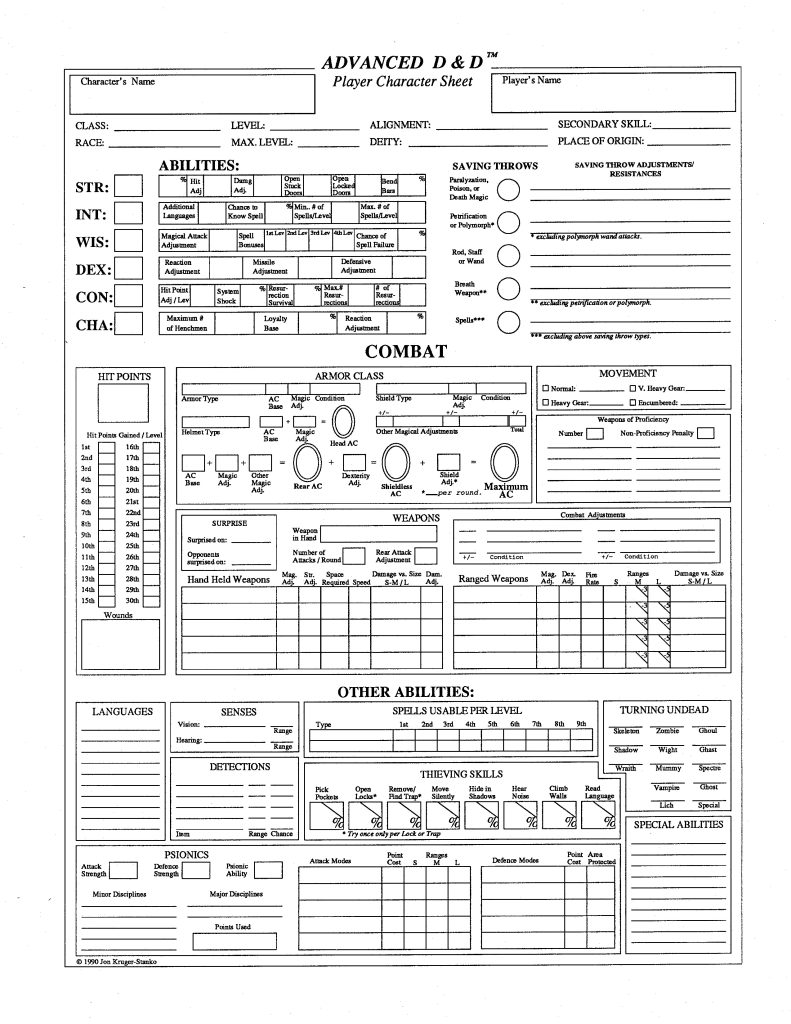
On the character sheet complexity scale, AD&D sits at a 5 on a 1-5 scale, although there are several items on an AD&D character sheet, such as weapon speed factors, that are optional. Skipping those makes it a 4 out of 5 for complexity. Race and class restrictions, separate saving throw categories by class and level, and a high number of situational modifiers all contribute to the load a player has to track.
AD&D Readability and Playability
Gygax’s writing is professorial and dense, often shifting from rules explanation into extended personal commentary on how the game should be run, particularly in the Dungeon Masters Guide.
Examples of actual play are limited. The Player’s Handbook has none, and the Dungeon Masters Guide offers a small number of sample combat rounds, considerably fewer than later rulebooks that rely more heavily on worked examples to teach new players.
No basic or simplified version of AD&D exists. TSR’s separate Basic Set, edited by Holmes and then later by Moldvay and then Mentzer, served as an entry point for new players at the time, but that product falls outside the scope of this review. Access to the AD&D core rules today requires either a used physical copy or the officially licensed PDF or reprint on the used book market.
Summary
AD&D places significant demands on a new player before it becomes intuitive, and it’s not a good choice for those brand new to the game without experienced DMs and other players in the group. Race and class restrictions, descending armor class, and a large collection of reference tables all require upfront learning, and the Dungeon Masters Guide reads more like an extended set of design opinions than a straightforward reference manual. For someone with no prior background in tabletop games, the learning curve is steep.
From the Dungeon Master’s side, the system is versatile and holds together once its individual pieces are learned, rewarding careful reading and a willingness to make rulings where the text is ambiguous or silent.
Approachability today depends largely on the reason for picking it up. For historical interest or an understanding of the mechanical foundations of the hobby, it’s an enjoyable edition. For an easy first introduction to tabletop roleplaying, other systems are better choices.


