

This review covers Shadowdark RPG, designed by Kelsey Dionne and published by The Arcane Library. Like Old-School Essentials, Shadowdark is rooted in the OSR tradition rather than built to compete directly with 5e on its own terms. Unlike Old-School Essentials, though, Shadowdark has increasingly become a real presence in how tables and online communities talk about it as an alternative, not through market share or sales figures, but through visibility, buzz, and social momentum that put it in the same conversation as Wizards of the Coast’s 800-pound gorilla.
History of Shadowdark RPG
Shadowdark launched on Kickstarter on February 28, 2023, and funded within days, ultimately raising roughly $1.3 to $1.4 million. A follow-up Kickstarter for the Western Reaches campaign setting funded for $2.4 million in April 2024, nearly double the original campaign, a sign of the game’s continued growth rather than a one-time surge of interest.
The game swept the 2024 ENNIE Awards, taking home four gold medals: Product of the Year, Best Game, Best Rules, and Best Layout & Design. It also won the 2024 Three Castles Award for game design.
Unlike AD&D and Old-School Essentials Advanced Fantasy, Shadowdark ships as a single core rulebook rather than a split player and referee set, running around 330 pages and containing everything needed to both play and run the game. The Basic rulebook from 1981 was complete in the sense that it contained information for both players and DMs, but it was limited to 3rd level characters and had a limited spell and monster inventory.
Shadowdark remains in print and is actively supported, sold through The Arcane Library’s own store, DriveThruRPG, and retail. A free Quickstart Set, containing a trimmed rules reference and a complete adventure, is also available as a legal download for anyone who wants to try the game before buying the core book.
Playing Shadowdark
Armor class is ascending, the 5e convention, rather than the descending AC used in AD&D and Basic D&D. Old-School Essentials offers ascending AC only as an optional rule; Shadowdark makes it the only option.
Initiative is determined individually per character by rolling a d20 and adding their Dexterity modifier. The DM does the same for the best monster in the group as well as for any NPCs they are controlling. Whichever gets the highest number goes first, and combat order goes clockwise around the table from there.
Advantage and disadvantage are adopted directly from 5e: roll two d20s and take the higher or lower result.
Player character death isn’t instant. At 0 hit points, a character is dying rather than dead outright. Roll 1d4 plus Constitution modifier, minimum 1, for the number of rounds before death arrives. On each of those rounds, rolling a natural 20 lets the character rise back up with 1 hit point, and an ally can stabilize a dying character with a close-range DC 15 Intelligence check, leaving them unconscious but no longer dying.
Spellcasting uses no spell slots. Instead, casters make a spellcasting check, a d20 roll plus the relevant modifier against a DC of 10 plus the spell’s tier, every time they attempt a spell. Failure means that specific spell can’t be attempted again until the caster rests, and a critical failure triggers a randomized mishap for wizards or requires performing penance for priests, whose displeased deity withholds further spells until it’s done. If the player succeeds on their spell check, that spell can be attempted again later on.
The game’s signature mechanic ties light sources to real-world time rather than in-game time: a torch burns out after one real hour at the table, regardless of how much or little happens in the fiction during that hour. Random encounter checks and rest timing follow the same real-time tracking, keeping the classic OSR resource-management tension intact while removing most of the bookkeeping that usually comes with it.
Experience is awarded through an abstracted treasure system rather than gold-for-XP or monster kills. A standard treasure find is worth 1 XP, better hoards are worth more, and the amount of XP needed to reach the next level scales with current level, 10 XP to advance from level 1, 20 XP to advance from level 2, and so on. Once a character goes up a level, their XP earned resets to zero.
Shadowdark Player Characters
Six ancestries are available, none of which have darkvision:
- Dwarf
- Elf
- Goblin
- Half-Orc
- Halfling
- Human
The four core classes are available:
- Fighter
- Priest
- Thief
- Wizard
There are no ancestry or class restrictions. Any ancestry can be any class, the same open approach used in 5e rather than the restricted or race-as-class models used in AD&D, Basic D&D, and Old-School Essentials.
Level cap is 10, the lowest of any edition in this series. This is well below AD&D’s near-unlimited human progression, Basic D&D’s 1-3 range within its own booklet, and 5e’s cap of 20.
Character creation uniquely supports an optional Level 0 funnel start, where new players begin as fragile ordinary folk with no class before surviving their way into an actual class at level 1.
Character advancement in Shadowdark also has some unique features. On leveling up, a character rolls their new class’s hit die, adding their Constitution bonus only once, at first level; every level after that adds the rolled hit die alone. They also roll on a class-specific Talent table that replaces the role feats and subclasses found in 5e. These talent rolls can grant ability score increases, combat bonuses, spellcasting improvements, or class-specific perks, and for wizards, a rare roll result even grants a random magic item outright.
This stands apart from AD&D, Basic D&D, and both 5e editions, which all let a player choose their advancement options, while Old-School Essentials falls somewhere in between depending on which classes are involved. Shadowdark instead leaves most of a character’s growth to the dice, trading build customization for the unpredictability that defines the rest of the game.
Given the tight four-class, six-ancestry scope and largely random character generation, creating a character here is faster than any other edition reviewed so far, comfortably under the 15-20 minutes estimated for Basic D&D, even for first-time players.
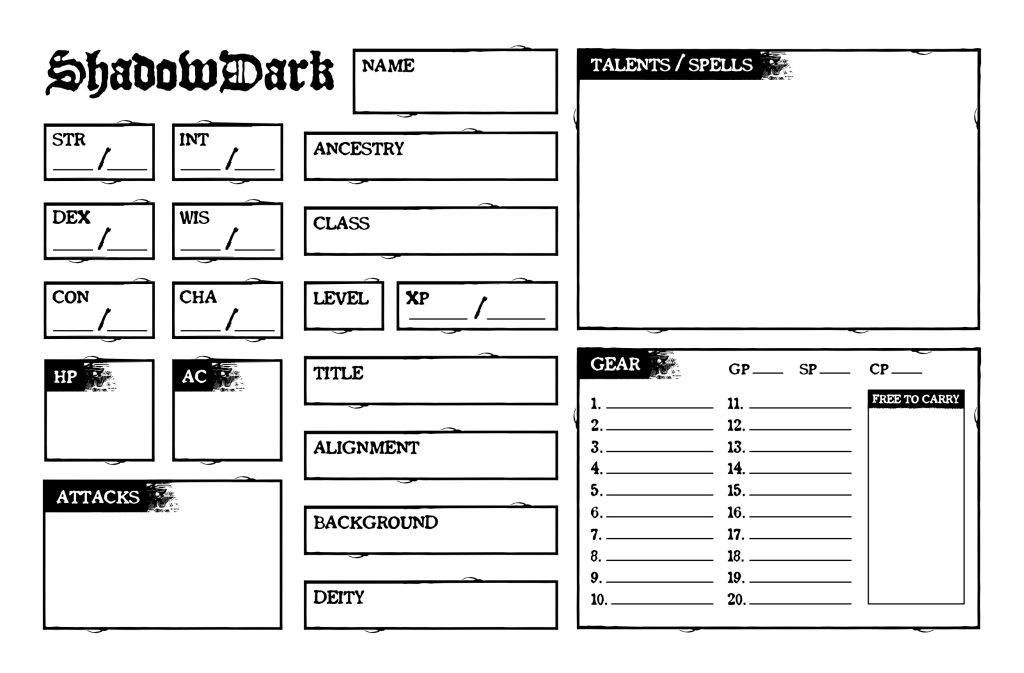
On the character sheet complexity scale, this edition sits at a 1, by far the easiest of our reviewed rules sets.
Shadowdark RPG Readability and Playability
The rulebook is built around two-page spreads that keep related rules physically close together, explicitly designed to minimize cross-referencing and keep the book out of the way once play starts.
A worked example of play is included, walking through an actual sequence of table events rather than describing rules in the abstract only.
The free Quickstart Set gives a group a complete, legal way to try the full game. It contains rules and an included adventure, for free, similar in spirit to Moldvay’s all-in-one approach and 5e’s free rules, though Shadowdark is built as a standalone starter product from the ground up rather than a trimmed slice of the core book.
Summary
Shadowdark takes the bones of B/X-style OSR play, tight classes, challenging resource management, fast character creation, and layers on a handful of ideas borrowed from 5e, ascending AC and advantage and disadvantage chief among them, while stripping away most of the character-build depth that defines the modern game. The result reads as neither a pure retroclone nor a 5e competitor in the direct sense, but a third option aimed at tables who want speed and lethality without relearning AD&D’s older, more idiosyncratic systems.
The Kickstarter numbers, the ENnie sweep, and a growing line of settings and supplements all point to real traction beyond the OSR’s usual audience. For groups exhausted by 5e’s character-build complexity but unwilling to take on AD&D’s discursive rulebook or Basic D&D’s dated presentation, Shadowdark occupies a real gap in the market, backed by a publisher still actively producing new material for it, and the sales figures suggest plenty of tables agree.
As an entry point, this is the fastest edition in this series to actually get a group playing, with the smallest class list, the lowest level cap, and the least character-build depth of anything reviewed here. That lack of complexity may read as reduced variety for players who prefer a long menu of options, however. What it asks of a new player up front is minimal. In essence, Shadowdark RPG gives you what you need to start playing D&D quickly and efficiently, then gets out of the way so you can focus on the game instead of the rules.


