

This review covers the 2024 revised core rules for 5th edition Dungeons & Dragons, published by Wizards of the Coast. Although many players refer to this as 5.5e, Wizards presents this as a revision of 5th edition rather than an officially new numbered edition, and it replaced the 2014 core books as the current product line while remaining largely compatible with them.
History of 5e (2024)
The revision was developed through the One D&D public playtest process, run through the Unearthed Arcana series across 2022 and 2023, gathering community feedback accumulated over the decade since the 2014 rules launched. Jeremy Crawford served as lead rules designer, the same role he held on the 2014 Player’s Handbook.
Release happened in stages, similar to 2014. The Player’s Handbook came first, releasing September 17, 2024, with early access to Local Game Stores on September 3 and staggered early access on D&D Beyond depending on subscription tier. The Dungeon Master’s Guide and a companion DM screen followed on November 12, 2024. The Monster Manual closed out the trilogy on February 18, 2025, still branded the “2024 Monster Manual” despite its actual release date falling in the following year.
Page counts grew across the board. The Player’s Handbook runs 384 pages, the largest in D&D’s history and up from 320 pages in 2014. The Monster Manual also grew to 384 pages, up from 352, and now contains more than 500 monsters, over 75 of them new.
Wizards of the Coast has stated that the 2024 Player’s Handbook printed three times as many copies as the 2014 Player’s Handbook’s initial run, and called it the fastest-selling D&D book in the game’s 50-year history. That framing has been disputed. Nielsen BookScan tracking of US physical retail sales showed the 2024 Player’s Handbook selling around 3,773 copies in its first week, compared to roughly 22,000 for the 2014 Player’s Handbook’s first week, suggesting the “fastest-selling” claim leans heavily on digital sales through D&D Beyond rather than physical retail. No independent lifetime sales total is available yet, since the book remains current.
Unlike the earlier editions covered in this series, this is the current, in-print product line, available new through retailers, Wizards of the Coast directly, and D&D Beyond.
Playing the Game
Armor class remains ascending, unchanged from 2014’s approach and still the opposite convention from AD&D and Basic D&D’s descending AC.
Initiative is still rolled individually, a d20 plus Dexterity modifier, the same as 2014.
Player character death still works through death saving throws, and this mechanic is unchanged from 2014: three net successes stabilize at 0 hit points, three net failures mean death, a natural 1 counts as two failures, and a natural 20 immediately restores 1 hit point and consciousness. Taking damage at 0 hit points still counts as an automatic failure, two on a critical hit, with instant death if that damage alone equals or exceeds the character’s hit point maximum.
Weapon Mastery is the biggest new combat mechanic introduced in this revision. Barbarians, Fighters, Monks, Paladins, Rangers, and Rogues, the classes most reliant on weapons, gain access to special properties tied to specific weapons, such as Cleave (hitting a second adjacent target after felling an enemy) or Vex (gaining advantage on your next attack against a target you’ve already hit). This system didn’t exist in 2014.
Experience still uses a single unified table shared by every class, unchanged from 2014, and the Dungeon Master’s Guide still offers a milestone-based alternative.
Advantage and disadvantage remain a key resolution mechanic, unchanged from 2014, and still the biggest structural difference from the situational modifiers used in AD&D and Basic D&D.
5e Player Characters
Species, the term now used in place of 2014’s “races,” number 10 in the core Player’s Handbook:
- Aasimar
- Dragonborn
- Dwarf
- Elf
- Gnome
- Goliath
- Halfling
- Human
- Orc
- Tiefling
Half-Elf and Half-Orc, both present in 2014, were dropped. Aasimar, Goliath, and Orc, all previously available only in supplement books, were added as core options.
Subraces have been eliminated entirely. No species offers a subrace choice anymore, a departure from 2014’s dwarf, elf, gnome, and halfling subrace options. Ability score increases have also moved away from species entirely. In 2014, a dwarf character always received the same ability score bonus regardless of class. In 2024, ability score increases come from the chosen background instead, so two dwarves with different backgrounds can start with entirely different ability scores.
Sixteen backgrounds are available, each granting a specific Origin feat, ability score increases, skill proficiencies, a tool proficiency, and starting equipment. This is a new structural role for backgrounds compared to 2014, where they mainly provided roleplaying flavor and skill proficiencies without feats or ability scores attached.
Seventy-five feats are available in total, including a new top tier called Epic Boon feats, reserved for high-level characters and offering some of the most powerful options in the book. Feats received far more emphasis structurally in this revision than in 2014, where they were an optional rule rather than a built-in part of character creation.
Twelve classes remain available, unchanged from 2014:
- Barbarian
- Bard
- Cleric
- Druid
- Fighter
- Monk
- Paladin
- Ranger
- Rogue
- Sorcerer
- Warlock
- Wizard
There are still no race or class restrictions of any kind, unchanged from 2014 and still a shared departure from both AD&D and Basic D&D.
Subclass selection is now standardized to level 3 for every class, a change from 2014, where selection ranged anywhere from level 1 to level 3 depending on the class. There are 48 total subclasses, four per class, a more even distribution than 2014’s lopsided norm of 2 or 3 per class, with Cleric at 7 and Wizard at 8. Some 2014 subclasses, three Cleric domains and four Wizard schools among them, were cut from this core book to make room for the standardized four-per-class format, though they remain usable alongside the new rules through the older books.
Level cap remains 20 across every class, with no race-based ceiling, unchanged from 2014.
The Player’s Handbook contains nearly 400 spells total, up from 361 in 2014, combining revised spells pulled from the 2014 Player’s Handbook, Xanathar’s Guide to Everything, and Tasha’s Cauldron of Everything, along with a small number of entirely new spells.
Character creation and advancement carry more real complexity in 2024 than in 2014, even though the book itself is organized to be easier to learn from. Weapon Mastery, a mandatory and more structured feat system, and the shift of ability scores from species to background all introduce interactions a 2014 character build never had to account for. A first-time player still needs roughly the same 30-45 minutes with a DM’s assistance to finish a first-level character (much longer if learning on their own), but leveling up and optimizing a build afterward asks more of the player than 2014 did.
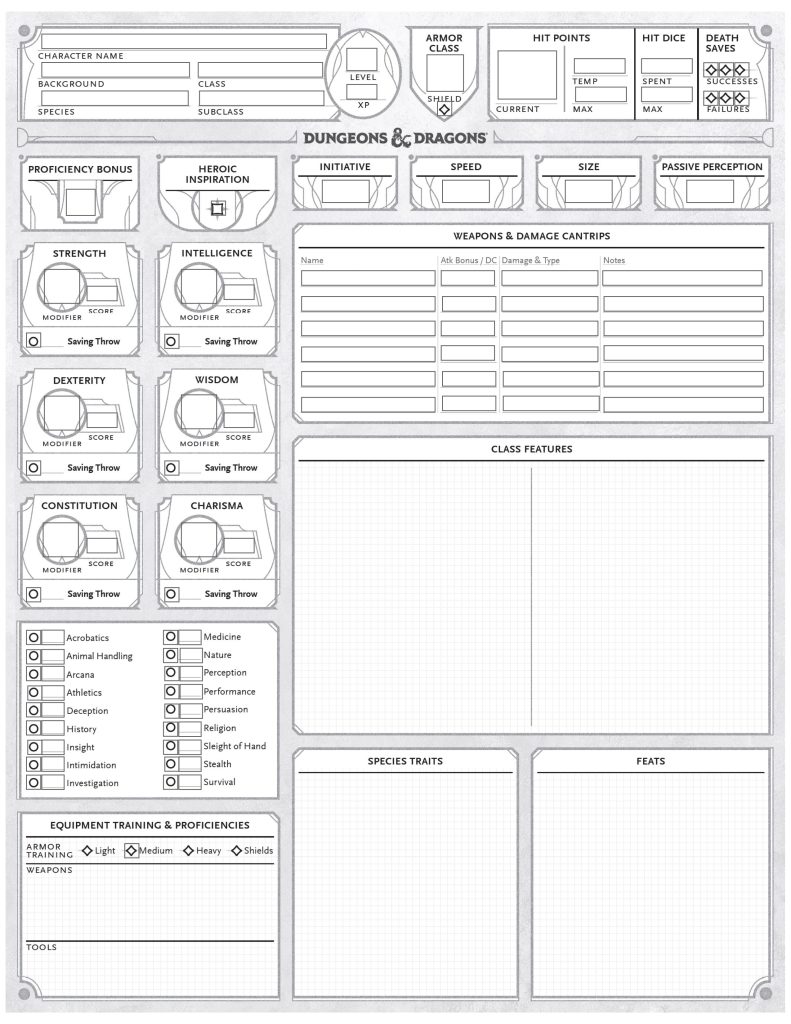
On the character sheet complexity scale, this edition moves up to a 5, a step above 2014’s 4. The improved layout makes rules easier to find, but the system a player actually has to track and apply has grown rather than simplified. Of every ruleset in this series still available for purchase today, official or third-party, this edition’s character creation and advancement is the most complex.
5e D&D Readability and Playability
The 2024 Player’s Handbook is written and organized to read better for a brand new player than the 2014 book. It includes a fuller step-by-step walkthrough of an actual turn of play early on, more numerous example call-out boxes throughout the combat and spellcasting sections, and an alphabetized rules glossary, a reference tool the 2014 book never had.
A free version of the rules, called the D&D Free Rules rather than Basic Rules, launched alongside early access on September 3, 2024, hosted on the D&D Beyond website rather than distributed as a standalone downloadable PDF the way the 2014 Basic Rules were. It initially covered four classes (Cleric, Fighter, Rogue, and Wizard), four species (Dwarf, Elf, Halfling, and Human), four backgrounds, and a trimmed spell and monster selection. By early 2025, it had expanded to include all 12 core classes, each with one subclass, though the full 48-subclass, 10-species range still requires the paid core book.
Summary
This revision keeps the core structure of 2014 fifth edition intact while addressing some of its rougher edges. Weapon Mastery gives martial classes more to do turn to turn, subclass timing is standardized across every class instead of varying by 1 to 3 levels, and feats and backgrounds now play a defined structural role in character creation rather than sitting off to the side as optional or purely flavorful choices.
From the Dungeon Master’s side, this book is organized to be easier to reference at the table, with the added rules glossary being the clearest improvement over 2014 in that respect. The core teaching challenge doesn’t change much: Cleric and Wizard still carry more built-in subclass depth than the other ten classes, even after the standardization to four subclasses apiece.
As an entry point to tabletop roleplaying, this edition holds the same basic position 2014 did relative to AD&D and Basic D&D, with no race or class restrictions, advantage and disadvantage instead of a long list of situational modifiers, and a single XP table for every class. The free online rules now cover more ground than 2014’s downloadable Basic Rules did at launch, though a first-time player working through character creation alone will find even more decisions to make than they would have in 2014.
There’s a philosophy some DMs hold that the rules should get out of the way so the table can focus on the game itself. Of every ruleset currently available today, this edition sits furthest from that ideal. The reorganized book, the added glossary, and the free online rules all make the system easier to learn about, but the system itself, once a group sits down to actually build and advance characters, asks more of the player at every stage than any other version reviewed here.


